
GCSE Maths (Edexcel)
435 videos | 33 hours
Please subscribe to watch this video.
This, and all other videos, are included in our premium subscriptions.
Premium accounts get access to all videos.
Enable autoplay to keep watching
Your browser is blocking videos from playing automatically. To turn it back on:
Safari (Mac): Click the Safari menu item in the top bar, then Settings → Websites → Auto-Play, then set Auto-Play to Allow All Auto-Play for the current website.
Safari (iPhone/iPad): open the Settings app, then Apps → Safari → Auto-Play, and select Allow All Auto-Play.
Combining Transformations
- Transformations can be combined by doing one transformation and then another
- The three types of transformations that can be combined are reflection, rotation, and translation
- Reflection is flipping an object across a mirror line
- Rotation is turning an object a certain number of degrees about a point
- Translation is moving an object without changing its size or orientation
- To combine transformations, perform each transformation one after the other
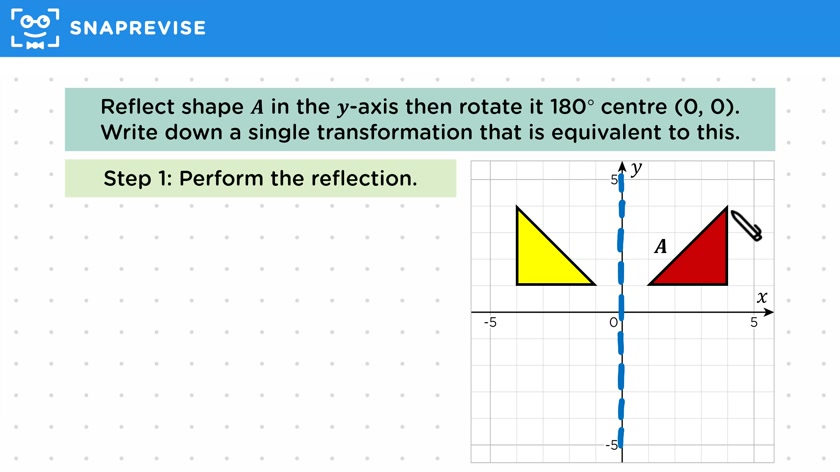
- In the example given, the first transformation is a reflection in the y axis
- The second transformation is a rotation of 180 degrees about the center (0,0)
- The final shape can be achieved by performing a reflection in the x axis using the mirror line of the original shape
- It is important to know how to combine transformations and recognize equivalent combinations of transformations.
Please subscribe to access these revision notes.
This, and all other video notes, are included in our premium subscriptions.
Premium accounts get access to all videos and revision notes.
372
questions for Geometry and measures
164
questions for Properties and constructions