
GCSE Maths (Edexcel)
435 videos | 33 hours
Please subscribe to watch this video.
This, and all other videos, are included in our premium subscriptions.
Premium accounts get access to all videos.
Enable autoplay to keep watching
Your browser is blocking videos from playing automatically. To turn it back on:
Safari (Mac): Click the Safari menu item in the top bar, then Settings → Websites → Auto-Play, then set Auto-Play to Allow All Auto-Play for the current website.
Safari (iPhone/iPad): open the Settings app, then Apps → Safari → Auto-Play, and select Allow All Auto-Play.
HCF & Prime Factorisations
- The highest common factor (HCF) can be found using prime factor trees and Venn diagrams.
- Prime factors are any primes that divide evenly into a number.
- Venn diagrams are a way of sorting data into groups called sets.
- In a Venn diagram, any number that goes inside both circles is written once in the intersection.
- The HCF is the product of all the numbers in the intersection of the Venn diagram.
- Other techniques can be used to find the HCF, but Venn diagrams are useful for visualizing the problem.
- To find the HCF of more than two numbers, draw more than two intersecting circles.
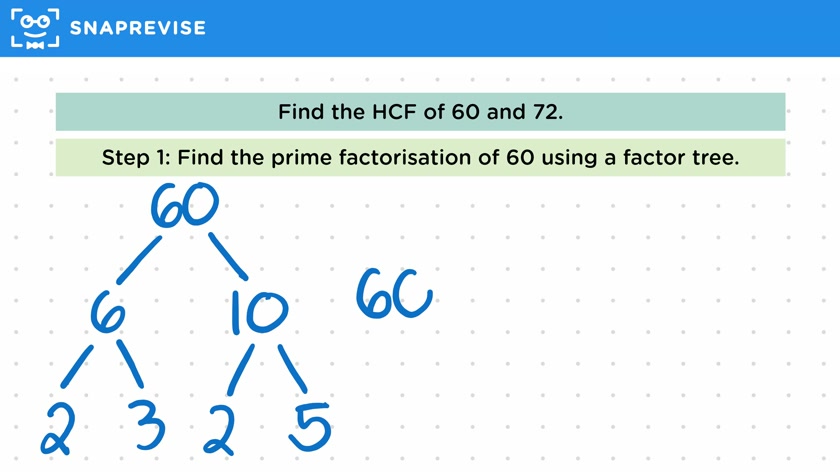
- Example: Find the HCF of 60 and 72.
- Step 1: Find the prime factorization of 60 using a factor tree.
- Step 2: Find the prime factorization of 72 using a factor tree.
- Step 3: Complete a Venn diagram with the prime factors of 60 and 72.
- Step 4: Find the HCF by multiplying the numbers in the overlap of the Venn diagram.
- The HCF of 60 and 72 is 12.
Please subscribe to access these revision notes.
This, and all other video notes, are included in our premium subscriptions.
Premium accounts get access to all videos and revision notes.
264
questions for Number
210
questions for Structure and calculation