
GCSE Maths (Edexcel)
435 videos | 33 hours
Please subscribe to watch this video.
This, and all other videos, are included in our premium subscriptions.
Premium accounts get access to all videos.
Enable autoplay to keep watching
Your browser is blocking videos from playing automatically. To turn it back on:
Safari (Mac): Click the Safari menu item in the top bar, then Settings → Websites → Auto-Play, then set Auto-Play to Allow All Auto-Play for the current website.
Safari (iPhone/iPad): open the Settings app, then Apps → Safari → Auto-Play, and select Allow All Auto-Play.
Interquartile Range
- The interquartile range is a measure of spread in a data set
- It is calculated by finding the difference between the upper quartile and the lower quartile
- The lower quartile is the data value a quarter of the way into the data set, while the upper quartile is three quarters of the way in
- The interquartile range focuses on the middle half of the data, ignoring the extreme values
- It is often more accurate than the range in measuring spread, as it is not affected by outliers as much
- To calculate the interquartile range, the data values must be in order
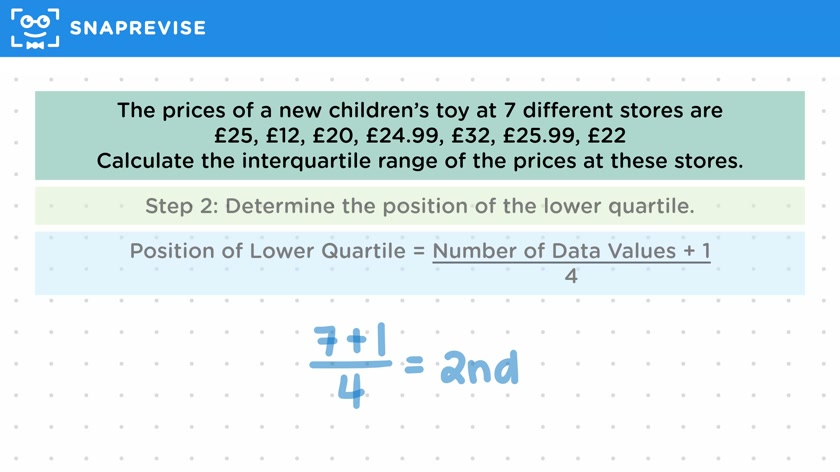
- The position of the lower quartile is (number of data values + 1) / 4
- The position of the upper quartile is 3 * (number of data values + 1) / 4
- The interquartile range is the difference between the values in the lower and upper quartiles
Please subscribe to access these revision notes.
This, and all other video notes, are included in our premium subscriptions.
Premium accounts get access to all videos and revision notes.
116
questions for Statistics
116
questions for Statistics