
GCSE Maths (Edexcel)
435 videos | 33 hours
Please subscribe to watch this video.
This, and all other videos, are included in our premium subscriptions.
Premium accounts get access to all videos.
Enable autoplay to keep watching
Your browser is blocking videos from playing automatically. To turn it back on:
Safari (Mac): Click the Safari menu item in the top bar, then Settings → Websites → Auto-Play, then set Auto-Play to Allow All Auto-Play for the current website.
Safari (iPhone/iPad): open the Settings app, then Apps → Safari → Auto-Play, and select Allow All Auto-Play.
Negative Scale Factors
- Enlargement with a negative scale factor produces an inverted image on the other side of the center of enlargement.
- The center of enlargement is a point that fixes the position of the enlargement.
- A straight line drawn from a point on the object through the center of enlargement will meet the corresponding point on the image.
- The scale factor of the enlargement is equal to the distance of a point on the image to the center divided by the distance of the corresponding point on the object to the center.
- The scale factor can also be calculated by dividing the length of the image by the length of the object.
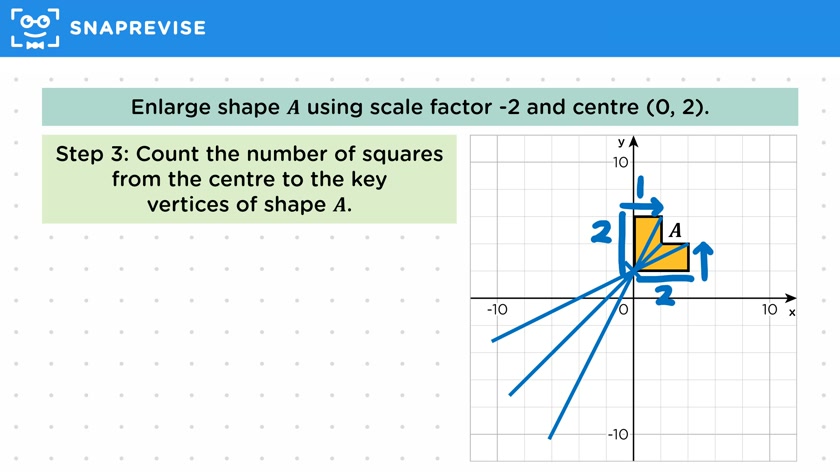
- To perform an enlargement with a negative scale factor, mark the center of enlargement on the grid and draw straight lines from the shape's vertices through the center.
- Count the number of squares from the center to the key vertices of the shape.
- Multiply these distances by the scale factor, ignoring the negative sign.
- Mark the points this distance away from the center of enlargement on the lines, in the opposite direction to the corresponding distances for the object.
- Use the marked points as the key vertices of the image to draw it, filling in the rest based on the proportions of the original object.
Please subscribe to access these revision notes.
This, and all other video notes, are included in our premium subscriptions.
Premium accounts get access to all videos and revision notes.
372
questions for Geometry and measures
164
questions for Properties and constructions