
GCSE Maths (Edexcel)
435 videos | 33 hours
Please subscribe to watch this video.
This, and all other videos, are included in our premium subscriptions.
Premium accounts get access to all videos.
Enable autoplay to keep watching
Your browser is blocking videos from playing automatically. To turn it back on:
Safari (Mac): Click the Safari menu item in the top bar, then Settings → Websites → Auto-Play, then set Auto-Play to Allow All Auto-Play for the current website.
Safari (iPhone/iPad): open the Settings app, then Apps → Safari → Auto-Play, and select Allow All Auto-Play.
Parallelogram Law
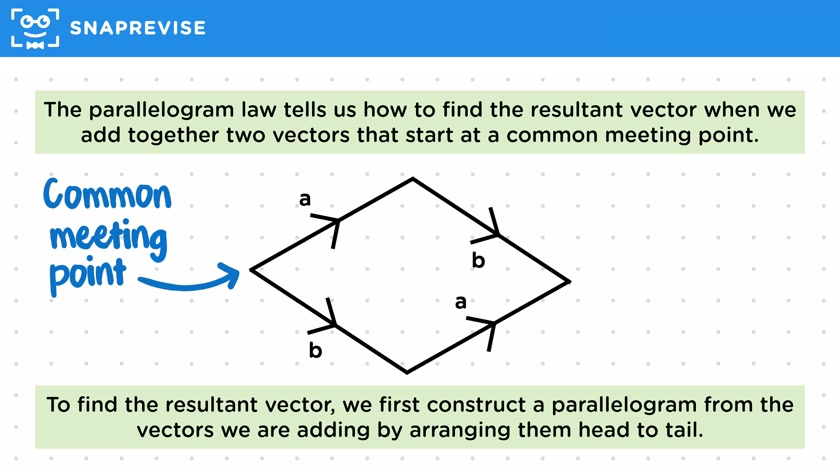
- Parallelogram law is used to find the resultant vector when adding two vectors with a common meeting point
- Vectors are arranged head to tail to form a parallelogram
- Opposite sides of the parallelogram are parallel to each other
- Resultant vector starts at the common meeting point and ends at the opposite vertex of the parallelogram
- Adding a new vector C to the parallelogram gives the resultant vector of A and B
- A + B = C
- Order of traveling along A and B doesn't matter, the overall journey is the same as traveling along C
- Parallelogram method should be used when adding vectors with a common meeting point
Please subscribe to access these revision notes.
This, and all other video notes, are included in our premium subscriptions.
Premium accounts get access to all videos and revision notes.
372
questions for Geometry and measures
18
questions for Vectors