
GCSE Maths (Edexcel)
435 videos | 33 hours
Please subscribe to watch this video.
This, and all other videos, are included in our premium subscriptions.
Premium accounts get access to all videos.
Enable autoplay to keep watching
Your browser is blocking videos from playing automatically. To turn it back on:
Safari (Mac): Click the Safari menu item in the top bar, then Settings → Websites → Auto-Play, then set Auto-Play to Allow All Auto-Play for the current website.
Safari (iPhone/iPad): open the Settings app, then Apps → Safari → Auto-Play, and select Allow All Auto-Play.
Petersen Capture-Recapture Method
- Determining the size of animal populations can be difficult
- Tagging or marking animals is one way to keep track of them, but it can be costly and time-consuming for large populations
- The Peterson capture recapture method is an alternative way to estimate wildlife populations
- The method involves capturing and tagging a sample of animals, releasing them back into the wild, and then capturing a second sample to count the number of tagged animals
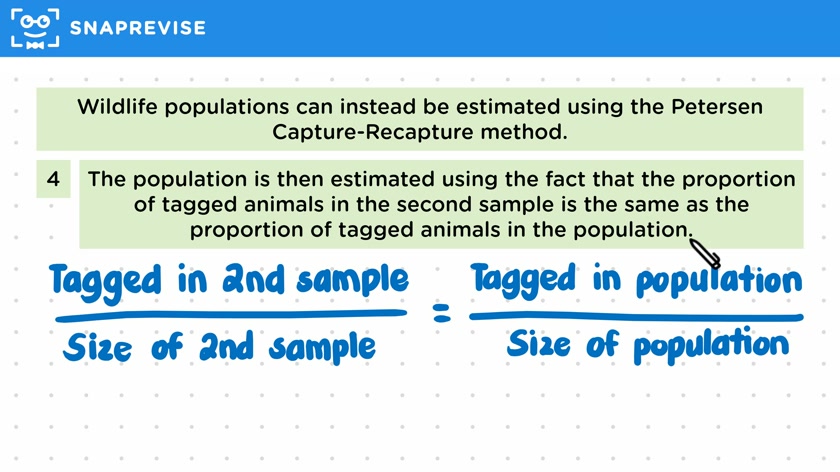
- The proportion of tagged animals in the second sample is assumed to be the same as the proportion in the population, allowing for the estimation of the population size
- The formula for estimating the population size is: size of population = (size of first sample * size of second sample) / number tagged in second sample
- The capture recapture method relies on certain assumptions, such as the population remaining unchanged between samples and all animals having an equal chance of being captured
- Potential issues with the method include changes in the population, variations in capture probability, and the loss of tags.
Please subscribe to access these revision notes.
This, and all other video notes, are included in our premium subscriptions.
Premium accounts get access to all videos and revision notes.
116
questions for Statistics
116
questions for Statistics