
GCSE Maths (Edexcel)
435 videos | 33 hours
Please subscribe to watch this video.
This, and all other videos, are included in our premium subscriptions.
Premium accounts get access to all videos.
Enable autoplay to keep watching
Your browser is blocking videos from playing automatically. To turn it back on:
Safari (Mac): Click the Safari menu item in the top bar, then Settings → Websites → Auto-Play, then set Auto-Play to Allow All Auto-Play for the current website.
Safari (iPhone/iPad): open the Settings app, then Apps → Safari → Auto-Play, and select Allow All Auto-Play.
Probability Experiments
- Probability experiments involve repeating an action numerous times and recording the outcomes
- Outcomes are the potential results of performing a random action, such as rolling a die or playing a game of football
- Probability experiments can be used to spot patterns and trends
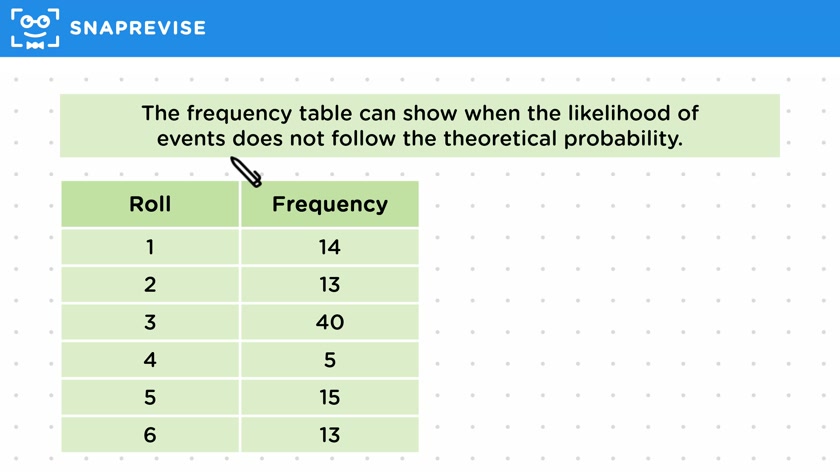
- The results of a probability experiment can be shown in a frequency table
- A frequency table lists the potential outcomes and the number of times each outcome occurs
- Frequency tables can show when the likelihood of events does not follow the theoretical probability
- Probability experiments can also show the likelihood of events that cannot be predicted through theoretical probabilities
- Probability experiments are useful for making qualitative comments on information from a frequency table
- Probability experiments can provide a feel for the probabilities of events that cannot be accurately predicted through theoretical probabilities
Please subscribe to access these revision notes.
This, and all other video notes, are included in our premium subscriptions.
Premium accounts get access to all videos and revision notes.
68
questions for Probability
68
questions for Probability