
GCSE Maths (Edexcel)
435 videos | 33 hours
Please subscribe to watch this video.
This, and all other videos, are included in our premium subscriptions.
Premium accounts get access to all videos.
Enable autoplay to keep watching
Your browser is blocking videos from playing automatically. To turn it back on:
Safari (Mac): Click the Safari menu item in the top bar, then Settings → Websites → Auto-Play, then set Auto-Play to Allow All Auto-Play for the current website.
Safari (iPhone/iPad): open the Settings app, then Apps → Safari → Auto-Play, and select Allow All Auto-Play.
Algebra
Graphs
Quadratic Intercepts & Roots
3:02
identify and interpret roots, intercepts, turning points of quadratic functions graphically; deduce roots algebraically and turning points by completing the square
Spec
A11
- Quadratic graphs have a y-intercept, which is the point where the graph intersects the y-axis.
- The y-intercept is found by determining the value of the variable c in the quadratic equation.
- The y-intercept can also be thought of as the y-coordinate when x is equal to zero.
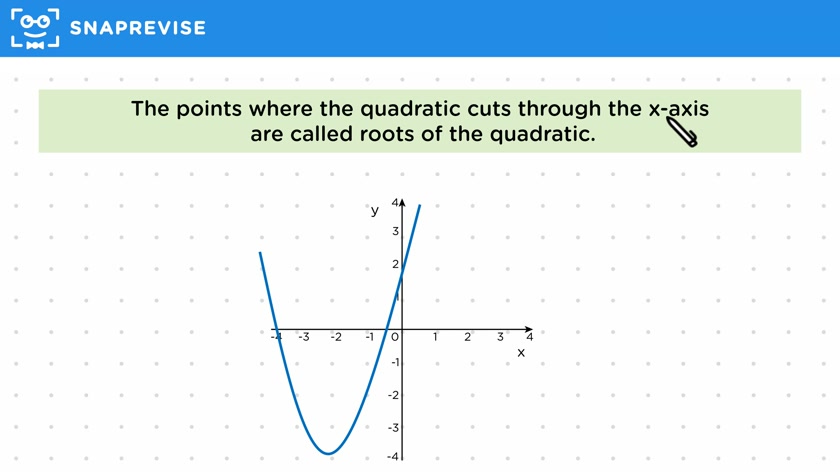
- The points where the quadratic graph crosses the x-axis are called roots of the quadratic.
- The roots can be calculated by setting y equal to zero and solving the quadratic equation.
- Quadratic graphs can have two, one, or zero x-intercepts.
- Two x-intercepts indicate two roots and two solutions to the quadratic equation.
- One x-intercept indicates a repeated root and one solution to the quadratic equation.
- No x-intercepts indicate no roots and no solutions to the quadratic equation.
Please subscribe to access these revision notes.
This, and all other video notes, are included in our premium subscriptions.
Premium accounts get access to all videos and revision notes.
310
questions for Algebra
95
questions for Graphs
Report an Issue
Spotted something wrong? Let us know and we'll take a look.