
GCSE Maths (Edexcel)
435 videos | 33 hours
Please subscribe to watch this video.
This, and all other videos, are included in our premium subscriptions.
Premium accounts get access to all videos.
Enable autoplay to keep watching
Your browser is blocking videos from playing automatically. To turn it back on:
Safari (Mac): Click the Safari menu item in the top bar, then Settings → Websites → Auto-Play, then set Auto-Play to Allow All Auto-Play for the current website.
Safari (iPhone/iPad): open the Settings app, then Apps → Safari → Auto-Play, and select Allow All Auto-Play.
Algebra
Graphs
Shape of a Reciprocal Graph
4:48
Recognise, sketch and interpret graphs of linear functions, quadratic functions, simple cubic functions, the reciprocal function y = 1/x with x ≠ 0, exponential functions y = kˣ for positive values of k, and the trigonometric functions (with arguments in degrees) y = sin x, y = cos x and y = tan x for angles of any size
Spec
A12
- A reciprocal function contains a term that is a reciprocal of x
- A reciprocal graph has a positive and negative portion
- As x increases, y decreases in a reciprocal graph
- As x decreases and becomes close to zero, y increases in a reciprocal graph
- Reciprocal graphs have two lines of symmetry
- The lines of symmetry split the graph into two symmetrical halves
- The first line of symmetry for the reciprocal function y is 1 over x is y = x
- The second line of symmetry for the reciprocal function y is 1 over x is y = -x
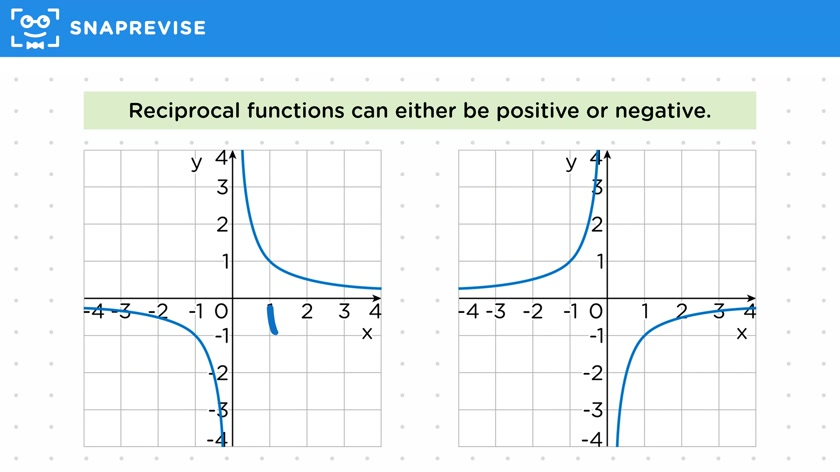
- Reciprocal functions can be positive or negative
- The graph of a positive reciprocal has positive y values when x is positive and negative y values when x is negative
- The graph of a negative reciprocal has negative y values when x is positive and positive y values when x is negative
- Regardless of the sign of the reciprocal function, the graphs have the same lines of symmetry
- Changing the size of the numerator in a reciprocal function changes the curvature of the graph
- A larger numerator makes the graph less curved and further away from the origin
- A smaller numerator makes the graph more curved and closer to the origin
Please subscribe to access these revision notes.
This, and all other video notes, are included in our premium subscriptions.
Premium accounts get access to all videos and revision notes.
310
questions for Algebra
95
questions for Graphs
Report an Issue
Spotted something wrong? Let us know and we'll take a look.