
GCSE Maths (Edexcel)
435 videos | 33 hours
Please subscribe to watch this video.
This, and all other videos, are included in our premium subscriptions.
Premium accounts get access to all videos.
Enable autoplay to keep watching
Your browser is blocking videos from playing automatically. To turn it back on:
Safari (Mac): Click the Safari menu item in the top bar, then Settings → Websites → Auto-Play, then set Auto-Play to Allow All Auto-Play for the current website.
Safari (iPhone/iPad): open the Settings app, then Apps → Safari → Auto-Play, and select Allow All Auto-Play.
Solutions to Quadratic Equations
- A quadratic equation involves constants, multiples of variables, and multiples of squared variables
- Quadratic equations are examples of non-linear equations
- Linear equations don't have squared terms, only constants and multiples of variables
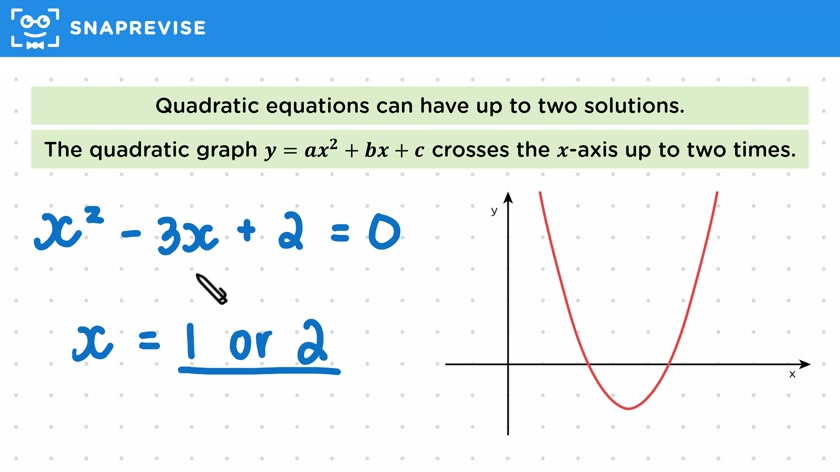
- Quadratic equations can have up to two solutions, while linear equations only have one solution
- The solutions of a quadratic equation are the values of the variables that satisfy the equation
- Quadratic equations can have two solutions because two numbers can square to give the same number (positive and negative)
- The graph of a quadratic equation crosses the x-axis up to two times
- Points on the graph of a quadratic equation represent the solutions to the equation
- It is a good idea to rearrange quadratic equations into the form ax^2 + bx + c = 0 to determine where the graph crosses the x-axis
- Quadratic equations can have one solution when the graph just touches the x-axis (repeated solution)
- Quadratic equations have no solutions when the graph does not touch the x-axis
Please subscribe to access these revision notes.
This, and all other video notes, are included in our premium subscriptions.
Premium accounts get access to all videos and revision notes.
310
questions for Algebra
83
questions for Solving equations and inequalities