
GCSE Maths (Edexcel)
435 videos | 33 hours
Please subscribe to watch this video.
This, and all other videos, are included in our premium subscriptions.
Premium accounts get access to all videos.
Enable autoplay to keep watching
Your browser is blocking videos from playing automatically. To turn it back on:
Safari (Mac): Click the Safari menu item in the top bar, then Settings → Websites → Auto-Play, then set Auto-Play to Allow All Auto-Play for the current website.
Safari (iPhone/iPad): open the Settings app, then Apps → Safari → Auto-Play, and select Allow All Auto-Play.
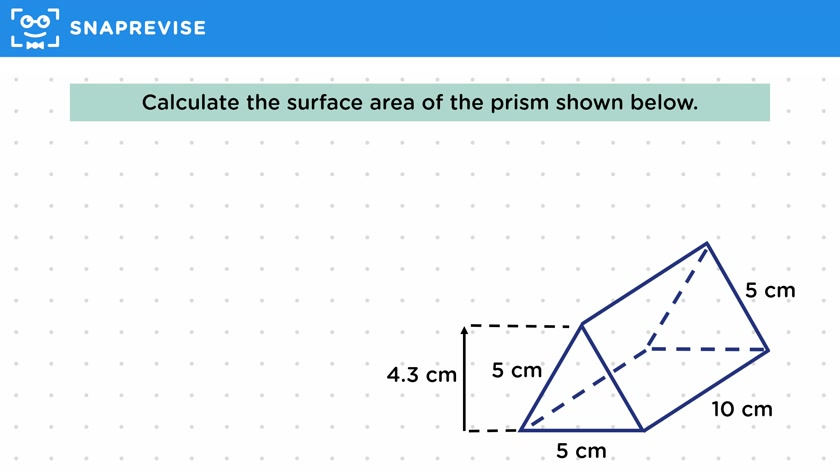
Surface Area of a Prism
- Surface area of a prism can be calculated by adding up the area of each of its faces
- The face opposite the base of a prism has an equal area
- When the base of a prism is a regular polygon, the remaining rectangular faces will have equal area
- The total surface area of a prism is equal to the area of the two base faces and the rectangular faces added together
- When the base of a prism is an irregular shape, the areas of the rectangular sides will be unequal
- To calculate the surface area of a prism, calculate the area of one base, multiply it by 2 for both bases, determine if the base is a regular polygon, calculate the area of one rectangular face, multiply it by the number of rectangular faces, and finally add together the area of the base faces and the rectangular faces to get the total surface area
Please subscribe to access these revision notes.
This, and all other video notes, are included in our premium subscriptions.
Premium accounts get access to all videos and revision notes.
372
questions for Geometry and measures
190
questions for Mensuration and calculation