
GCSE Maths (Edexcel)
435 videos | 33 hours
Please subscribe to watch this video.
This, and all other videos, are included in our premium subscriptions.
Premium accounts get access to all videos.
Enable autoplay to keep watching
Your browser is blocking videos from playing automatically. To turn it back on:
Safari (Mac): Click the Safari menu item in the top bar, then Settings → Websites → Auto-Play, then set Auto-Play to Allow All Auto-Play for the current website.
Safari (iPhone/iPad): open the Settings app, then Apps → Safari → Auto-Play, and select Allow All Auto-Play.
The Sine Rule
- The sine rule allows you to calculate angles and sides in a triangle that is not a right angle triangle.
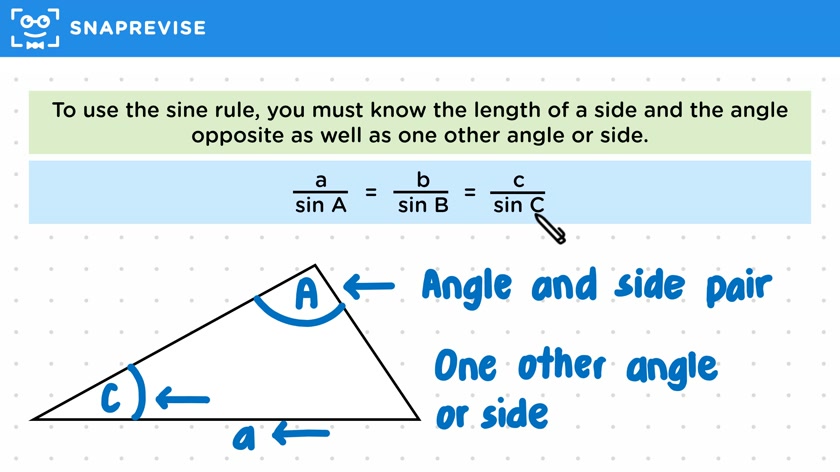
- The sine rule can be written as lowercase a over sine of capital A equals lowercase b over sine of capital B equals lowercase c over sine of capital C.
- Lowercase letters represent sides and uppercase letters represent angles.
- To use the sine rule, you must know the length of a side and the angle opposite, as well as one other angle or side.
- The sine rule can be rewritten so that the sine of each angle is on the numerator and each side length is on the denominator.
- The second form of the sine rule is easier to use if trying to work out an angle.
- Example: Using the sine rule to calculate the length of side x in a scalene triangle.
Please subscribe to access these revision notes.
This, and all other video notes, are included in our premium subscriptions.
Premium accounts get access to all videos and revision notes.
372
questions for Geometry and measures
190
questions for Mensuration and calculation