
GCSE Maths (Edexcel)
435 videos | 33 hours
Please subscribe to watch this video.
This, and all other videos, are included in our premium subscriptions.
Premium accounts get access to all videos.
Enable autoplay to keep watching
Your browser is blocking videos from playing automatically. To turn it back on:
Safari (Mac): Click the Safari menu item in the top bar, then Settings → Websites → Auto-Play, then set Auto-Play to Allow All Auto-Play for the current website.
Safari (iPhone/iPad): open the Settings app, then Apps → Safari → Auto-Play, and select Allow All Auto-Play.
Time Calculations
- Units of time such as seconds, minutes, and hours are used to measure the duration of events.
- One hour is equal to 60 minutes and each minute contains 60 seconds, so one hour is equal to 3,600 seconds.
- Digital clocks display the time with hours on the left and minutes on the right, separated by a colon.
- When the minute number reaches the sixtieth minute of the hour, the hour number increases by one and the minute number resets to zero.
- There are 24 hours in a day, so once the 24th hour is reached, the hour and minute numbers reset to zero.
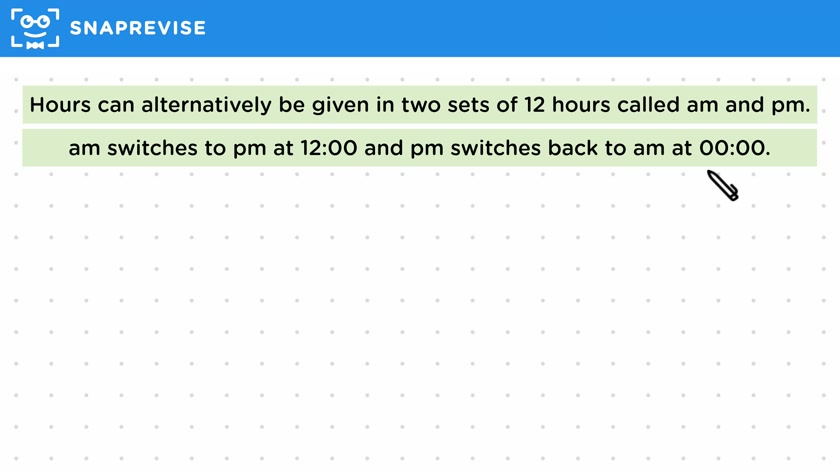
- Hours can be given in two sets of 12 hours, called a.m. and p.m.
- A.m. stands for anti meridium (before midday) and p.m. stands for post meridium (after midday).
- In the 24-hour clock, 2:37 a.m. is written as 02:37, while 2:37 p.m. is written as 14:37.
- When converting from a.m. to the 24-hour clock, the hours are written as a two-digit number.
- When converting from p.m. to the 24-hour clock, 12 is added to the number of hours.
- The exceptions are 12 a.m., which becomes 00 in the 24-hour clock, and 12 p.m., which stays as 12.
- A football match that starts at 9:45 and lasts for 105 minutes will end at 11:30.
Please subscribe to access these revision notes.
This, and all other video notes, are included in our premium subscriptions.
Premium accounts get access to all videos and revision notes.
372
questions for Geometry and measures
190
questions for Mensuration and calculation