
GCSE Maths (Edexcel)
435 videos | 33 hours
Please subscribe to watch this video.
This, and all other videos, are included in our premium subscriptions.
Premium accounts get access to all videos.
Enable autoplay to keep watching
Your browser is blocking videos from playing automatically. To turn it back on:
Safari (Mac): Click the Safari menu item in the top bar, then Settings → Websites → Auto-Play, then set Auto-Play to Allow All Auto-Play for the current website.
Safari (iPhone/iPad): open the Settings app, then Apps → Safari → Auto-Play, and select Allow All Auto-Play.
Unit Ratios & Scales
- A unit ratio is a ratio in which one side is one
- Examples of unit ratios include 1 to 50 and 2 to 1
- The ratio 3 to 4 is not a unit ratio
- Any ratio can be converted to a unit ratio by scaling through division
- Unit ratios are useful for maps and diagrams drawn to scale
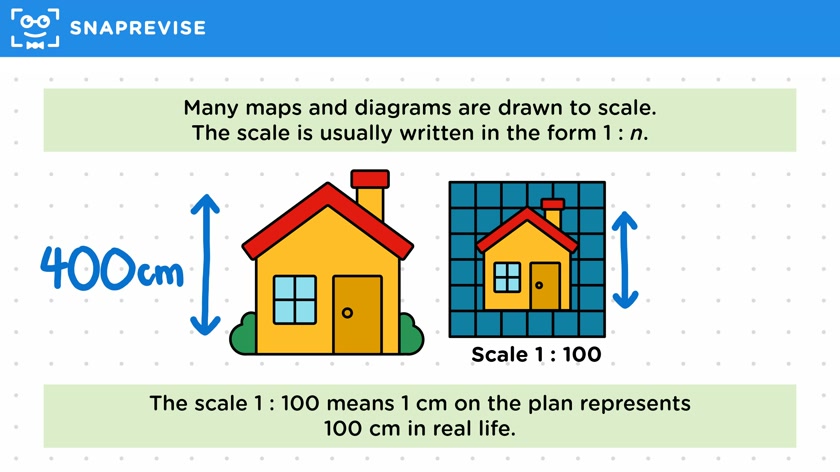
- The scale is usually written in the form 1 to n
- Scale drawings represent a ratio between the plan and the real object
- An example is given with a scale of 1 to 500
- The height of the castle on the plan is 6 centimeters
- To find the height in real life, both sides of the ratio are multiplied by 6
- The real life height of the castle is 3000 centimeters
- To convert to meters, the height is divided by 100
- The castle is 30 meters high in real life
Please subscribe to access these revision notes.
This, and all other video notes, are included in our premium subscriptions.
Premium accounts get access to all videos and revision notes.
75
questions for Ratio, proportion and rates of change
75
questions for Ratio, Proportion and Rates of Change