
GCSE Maths (Edexcel)
435 videos | 33 hours
Please subscribe to watch this video.
This, and all other videos, are included in our premium subscriptions.
Premium accounts get access to all videos.
Enable autoplay to keep watching
Your browser is blocking videos from playing automatically. To turn it back on:
Safari (Mac): Click the Safari menu item in the top bar, then Settings → Websites → Auto-Play, then set Auto-Play to Allow All Auto-Play for the current website.
Safari (iPhone/iPad): open the Settings app, then Apps → Safari → Auto-Play, and select Allow All Auto-Play.
Using Trig Functions in Other Shapes
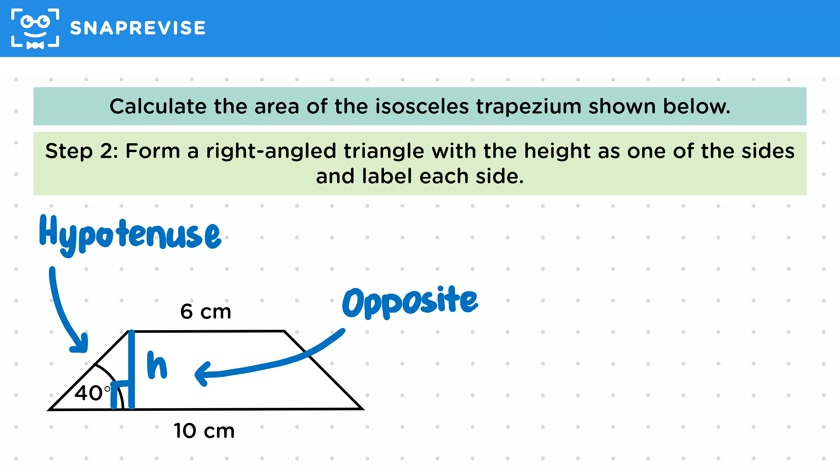
- Trig functions can be used to work out lengths and angles in other shapes by splitting the shape up into right angle triangles
- In a right angle triangle, the longest side is the hypotenuse, the side next to the given angle is the adjacent, and the side opposite the given angle is the opposite
- Trigonometry or Pythagoras theorem may be required to solve geometric problems
- In an isosceles trapezium, the two non-parallel sides have the same length, and there is a line of symmetry down the middle
- The area of a trapezium can be calculated using the formula A + B times H over two, where A and B are the lengths of the parallel sides and H is the height
- The height of the trapezium can be calculated using trigonometry
- The adjacent side of the right angle triangle can be calculated by taking the difference between the two parallel sides of the trapezium and dividing by two
- The height can be calculated using the adjacent side and the tan function
- The area of the trapezium can be calculated by substituting the height and given lengths into the formula
- The answer should be given to three significant figures
Please subscribe to access these revision notes.
This, and all other video notes, are included in our premium subscriptions.
Premium accounts get access to all videos and revision notes.
372
questions for Geometry and measures
190
questions for Mensuration and calculation