
GCSE Maths (AQA)
435 videos | 33 hours
Please subscribe to watch this video.
This, and all other videos, are included in our premium subscriptions.
Premium accounts get access to all videos.
Enable autoplay to keep watching
Your browser is blocking videos from playing automatically. To turn it back on:
Safari (Mac): Click the Safari menu item in the top bar, then Settings → Websites → Auto-Play, then set Auto-Play to Allow All Auto-Play for the current website.
Safari (iPhone/iPad): open the Settings app, then Apps → Safari → Auto-Play, and select Allow All Auto-Play.
Algebra
Graphs
Interpreting Non-Linear Gradients
3:44
calculate or estimate gradients of graphs and areas under graphs (including quadratic and other non-linear graphs), and interpret results in cases such as distance-time graphs, velocity-time graphs and graphs in financial contexts
Spec
A15
- The gradient of a non-linear graph is always changing, indicating that the rate of change also changes.
- The gradient is determined by dividing the change in the y variable by the change in the x variable.
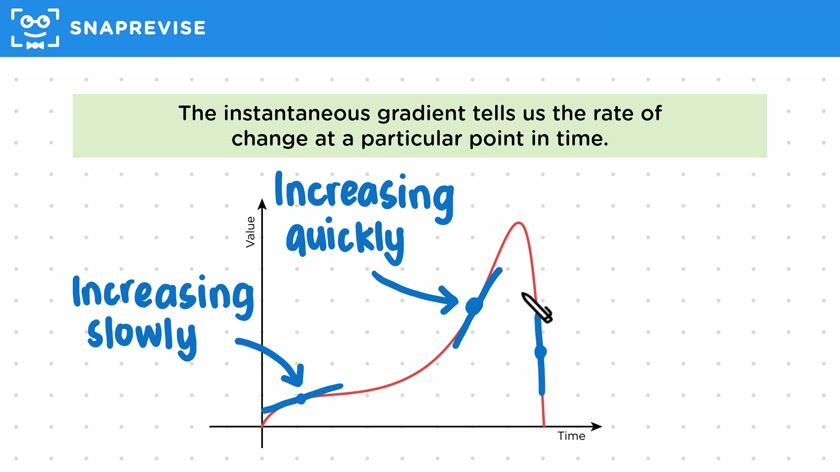
- The instantaneous gradient is the rate of change at a specific point in time, determined by drawing a tangent line to the curve.
- The gradient of the tangent line indicates the instantaneous rate of change.
- The gradient of a chord, a straight line drawn between two points, indicates the average rate of change over a period of time.
- Working out the gradient of a chord is useful for determining the average rate of change, but it loses the detail of how the value changed between the two points.
- Instantaneous gradient is like looking at the speedometer in a car, while the average gradient is like calculating the average speed over the entire journey.
Please subscribe to access these revision notes.
This, and all other video notes, are included in our premium subscriptions.
Premium accounts get access to all videos and revision notes.
310
questions for Algebra
95
questions for Graphs
Report an Issue
Spotted something wrong? Let us know and we'll take a look.