
GCSE Maths (AQA)
435 videos | 33 hours
Please subscribe to watch this video.
This, and all other videos, are included in our premium subscriptions.
Premium accounts get access to all videos.
Enable autoplay to keep watching
Your browser is blocking videos from playing automatically. To turn it back on:
Safari (Mac): Click the Safari menu item in the top bar, then Settings → Websites → Auto-Play, then set Auto-Play to Allow All Auto-Play for the current website.
Safari (iPhone/iPad): open the Settings app, then Apps → Safari → Auto-Play, and select Allow All Auto-Play.
Pythagoras' Theorem
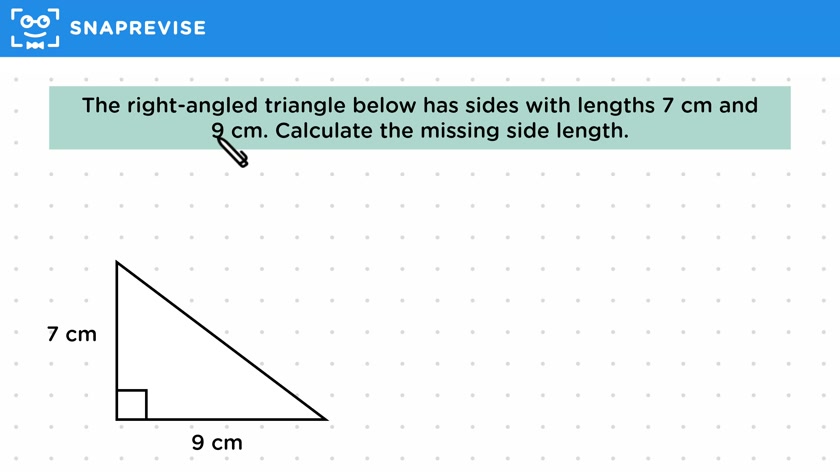
- Pythagoras theorem states that for a right angled triangle, the square of the hypotenuse is equal to the sum of the squares of the other sides.
- The hypotenuse is the longest side of a right angled triangle.
- The theorem can be written algebraically as the formula a squared plus b squared is c squared, where a, b, and c are the sides of the triangle.
- The theorem can be visually represented by drawing squares on each side of the triangle.
- The area of the largest square is equal to the sum of the areas of the two smaller squares.
- The equation of Pythagoras theorem can be rearranged to calculate either of the two shorter sides of the triangle.
- To calculate the hypotenuse, use the equation C is the square root of A squared plus B squared.
- To calculate one of the other sides, rearrange the equation to make the missing side the subject and use the equation A is equal to the square root of C squared minus B squared (or vice versa).
- It doesn't matter which side is labeled A or B, the answer will be the same.
Please subscribe to access these revision notes.
This, and all other video notes, are included in our premium subscriptions.
Premium accounts get access to all videos and revision notes.
372
questions for Geometry and measures
190
questions for Mensuration and calculation