
GCSE Maths (AQA)
435 videos | 33 hours
Please subscribe to watch this video.
This, and all other videos, are included in our premium subscriptions.
Premium accounts get access to all videos.
Enable autoplay to keep watching
Your browser is blocking videos from playing automatically. To turn it back on:
Safari (Mac): Click the Safari menu item in the top bar, then Settings → Websites → Auto-Play, then set Auto-Play to Allow All Auto-Play for the current website.
Safari (iPhone/iPad): open the Settings app, then Apps → Safari → Auto-Play, and select Allow All Auto-Play.
Spheres
- A sphere is a solid shape with one curved surface, no edges, and no vertices
- A sphere is three-dimensional and round
- 3D shapes are formed by surfaces called faces, edges are formed when two faces meet, and vertices are formed when two or more edges meet
- A sphere is made of just one continuous face, so it doesn't have any edges or vertices
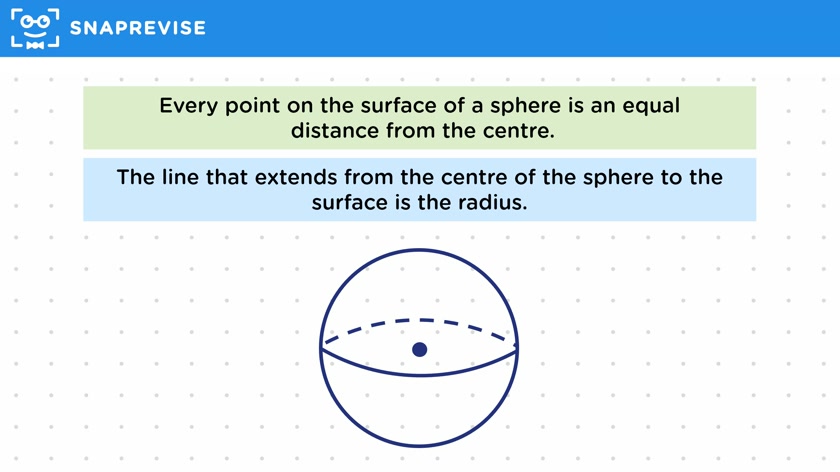
- The line that extends from the center of a sphere to the surface is called the radius
- Every point on the surface of a sphere is an equal distance from the center
- Real-world examples of spheres include manmade objects like footballs and natural objects like the planet Earth
- These objects are only approximately spherical, as they have imperfections in their surfaces
- Real-world examples are good to be aware of, but not necessary for exams.
Please subscribe to access these revision notes.
This, and all other video notes, are included in our premium subscriptions.
Premium accounts get access to all videos and revision notes.
372
questions for Geometry and measures
164
questions for Properties and constructions