

Topic Summaries
Development of atomic models
Energy and power
Renewable energy and efficiency
Charge, current, and electric fields
Potential difference and resistors
Electricity
Volume and gases
States of matter and heat capacity
Radiation
Nuclear fusion and fission
Forces
Velocity and acceleration
Gravity and Newton's Laws
Moments and elastic potential
Stopping, braking, and momentum
Properties of waves
Electromagnetic waves
Refraction and lenses
Light, colour, and ray diagrams
Absorbing and emitting infrared radiation
Magnetic fields
Motor effect, generator effect, and transformers
Science skills: Experimental procedures
Science skills: Presenting and using data
Science skills: Measuring results
Energy and power
Renewable energy and efficiency
Charge, current, and electric fields
Potential difference and resistors
Electricity
Volume and gases
States of matter and heat capacity
Radiation
Nuclear fusion and fission
Forces
Velocity and acceleration
Gravity and Newton's Laws
Moments and elastic potential
Stopping, braking, and momentum
Properties of waves
Electromagnetic waves
Refraction and lenses
Light, colour, and ray diagrams
Absorbing and emitting infrared radiation
Magnetic fields
Motor effect, generator effect, and transformers
Science skills: Experimental procedures
Science skills: Presenting and using data
Science skills: Measuring results
- The idea of an atom as a tiny sphere that could not be divided was first suggested by Democritus in ancient Greece. This idea has evolved over time with new evidence.
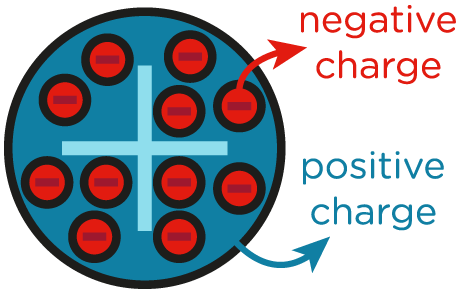
- The discovery of the electron led J. J. Thomson to suggest the “plum pudding” model of the atom in 1904:
- The atom consists of a sphere of positive charge that is evenly spread throughout.
- Negatively charged electrons are dotted around this sphere.
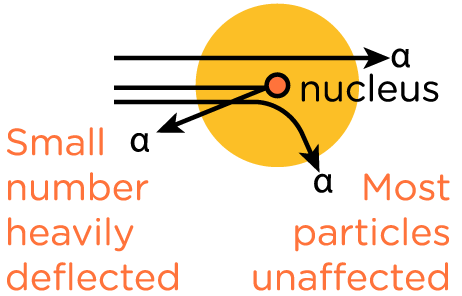
- Geiger and Marsden’s alpha scattering experiment led to Rutherford suggesting the nuclear model of the atom in 1911:
- Alpha particles were fired at a thin sheet of gold foil. The plum pudding model suggested the alpha particles would pass straight through the foil.
- Instead, a small number experience slight deflections with an even smaller number experiencing heavy deflections.
- The nuclear model of the atom suggests the atom consists of mostly empty space. Almost all the mass and all the positive charge of the atom is contained in a very small nucleus.
- Later experiments led to the conclusion that the positive charge of the nucleus could be subdivided into smaller particles called protons.
- Niels Bohr adapted the nuclear model in 1913 to explain the role of electrons in the atom:
- Electrons orbit the nucleus in set energy levels. These electrons emit or absorb electromagnetic radiation to change levels.
- Bohr’s theoretical calculations around these energy levels were later supported by experimental observations.
- In 1932, James Chadwick discovered that the nucleus also contained uncharged neutrons, which contribute to its mass.
Unlock Development of atomic models
Subscribe to SnapRevise+ to get immediate access to the rest of this resource.
Premium accounts get immediate access to this resource.