

Topic Summaries
Calculating change in momentum (HT ONLY)
Energy and power
Renewable energy and efficiency
Charge, current, and electric fields
Potential difference and resistors
Electricity
Volume and gases
States of matter and heat capacity
Radiation
Nuclear fusion and fission
Forces
Velocity and acceleration
Gravity and Newton's Laws
Moments and elastic potential
Stopping, braking, and momentum
Properties of waves
Electromagnetic waves
Refraction and lenses
Light, colour, and ray diagrams
Absorbing and emitting infrared radiation
Magnetic fields
Motor effect, generator effect, and transformers
Science skills: Experimental procedures
Science skills: Presenting and using data
Science skills: Measuring results
Energy and power
Renewable energy and efficiency
Charge, current, and electric fields
Potential difference and resistors
Electricity
Volume and gases
States of matter and heat capacity
Radiation
Nuclear fusion and fission
Forces
Velocity and acceleration
Gravity and Newton's Laws
Moments and elastic potential
Stopping, braking, and momentum
Properties of waves
Electromagnetic waves
Refraction and lenses
Light, colour, and ray diagrams
Absorbing and emitting infrared radiation
Magnetic fields
Motor effect, generator effect, and transformers
Science skills: Experimental procedures
Science skills: Presenting and using data
Science skills: Measuring results
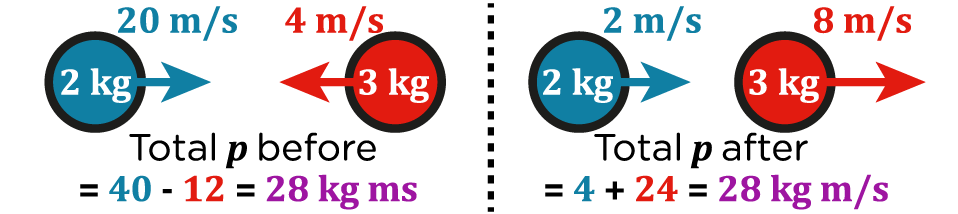
- Calculations involving conservation of momentum can be solved by calculating the total momentum before and after an event and equating them.
- If two objects are travelling in the same direction, their momentums are added.
- If two objects are travelling in opposite directions, then their momentums are subtracted.
- Combining the equations \(F=ma\) and \(a=\dfrac{\Delta v}{t}\) leads to the relation between force and momentum: \(F=\dfrac{m\Delta v}{t}\). This equation shows that force is equal to the rate of change of momentum.
- To stop moving, a force must be applied to change momentum to zero. Increasing the time it takes to stop will reduce the rate of change of momentum and the force. This principle is applied in numerous safety features such as crash mats and other cushioned surfaces, helmets, shin pads and other protective gear, seat belts and airbags in cars, and crumple zones, which collapse during a collision.
Unlock Calculating change in momentum (HT ONLY)
Subscribe to SnapRevise+ to get immediate access to the rest of this resource.
Premium accounts get immediate access to this resource.