
GCSE Physics (OCR B)
Topic Summaries
Nuclear fusion and fission
Nuclear fission
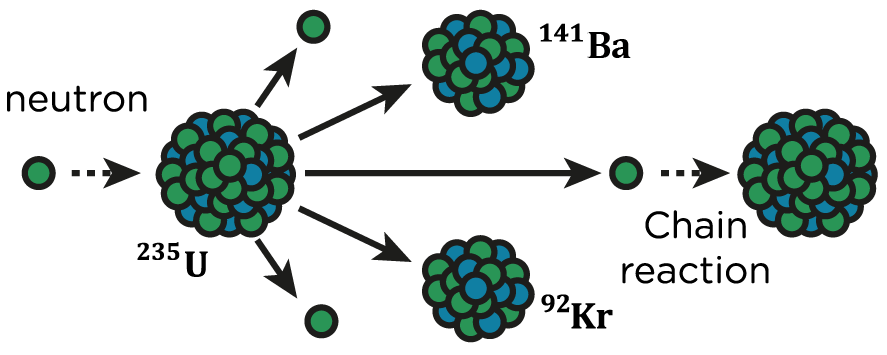
- Nuclear fission is the process of a large, unstable nucleus splitting into two smaller nuclei. These two nuclei are similar in size but rarely identical.
- Gamma rays will also be released after the fission reaction, along with 2 or 3 neutrons.
- Fission rarely happens spontaneously. It is typically induced by a neutron colliding with the unstable nucleus. The neutrons released in the fission reaction can then collide with other unstable nuclei to cause a chain reaction.
- A large amount of energy is released in the reaction:
- The smaller nuclei gain kinetic energy due to their electrostatic repulsion.
- This energy is transferred to the internal energy of atoms the nuclei collide with, raising the temperature of the system.
Unlock Nuclear fission
Sign up to unlock the rest of this topic — plus every other topic, video, flashcard set and eBook guide in your SnapRevise Digital subscription.
Cancel anytime — instant access the moment you sign up.
Report an Issue
Spotted something wrong? Let us know and we'll take a look.