

Topic Summaries
Nuclear fission
Energy and power
Renewable energy and efficiency
Charge, current, and electric fields
Potential difference and resistors
Electricity
Volume and gases
States of matter and heat capacity
Radiation
Nuclear fusion and fission
Forces
Velocity and acceleration
Gravity and Newton's Laws
Moments and elastic potential
Stopping, braking, and momentum
Properties of waves
Electromagnetic waves
Refraction and lenses
Light, colour, and ray diagrams
Absorbing and emitting infrared radiation
Magnetic fields
Motor effect, generator effect, and transformers
Science skills: Experimental procedures
Science skills: Presenting and using data
Science skills: Measuring results
Energy and power
Renewable energy and efficiency
Charge, current, and electric fields
Potential difference and resistors
Electricity
Volume and gases
States of matter and heat capacity
Radiation
Nuclear fusion and fission
Forces
Velocity and acceleration
Gravity and Newton's Laws
Moments and elastic potential
Stopping, braking, and momentum
Properties of waves
Electromagnetic waves
Refraction and lenses
Light, colour, and ray diagrams
Absorbing and emitting infrared radiation
Magnetic fields
Motor effect, generator effect, and transformers
Science skills: Experimental procedures
Science skills: Presenting and using data
Science skills: Measuring results
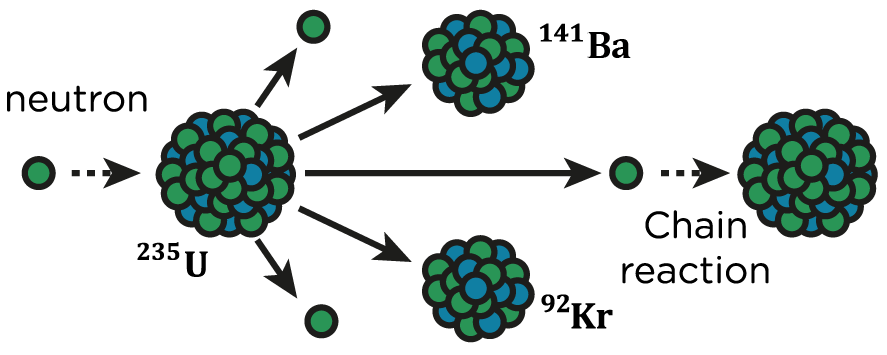
- Nuclear fission is the process of a large, unstable nucleus splitting into two smaller nuclei. These two nuclei are similar in size but rarely identical.
- Gamma rays will also be released after the fission reaction, along with 2 or 3 neutrons.
- Fission rarely happens spontaneously. It is typically induced by a neutron colliding with the unstable nucleus. The neutrons released in the fission reaction can then collide with other unstable nuclei to cause a chain reaction.
- A large amount of energy is released in the reaction:
- The smaller nuclei gain kinetic energy due to their electrostatic repulsion.
- This energy is transferred to the internal energy of atoms the nuclei collide with, raising the temperature of the system.
Unlock Nuclear fission
Subscribe to SnapRevise+ to get immediate access to the rest of this resource.
Premium accounts get immediate access to this resource.