

Topic Summaries
Transverse and longitudinal waves
Energy and power
Renewable energy and efficiency
Charge, current, and electric fields
Potential difference and resistors
Electricity
Volume and gases
States of matter and heat capacity
Radiation
Nuclear fusion and fission
Forces
Velocity and acceleration
Gravity and Newton's Laws
Moments and elastic potential
Stopping, braking, and momentum
Properties of waves
Electromagnetic waves
Refraction and lenses
Light, colour, and ray diagrams
Absorbing and emitting infrared radiation
Magnetic fields
Motor effect, generator effect, and transformers
Science skills: Experimental procedures
Science skills: Presenting and using data
Science skills: Measuring results
Energy and power
Renewable energy and efficiency
Charge, current, and electric fields
Potential difference and resistors
Electricity
Volume and gases
States of matter and heat capacity
Radiation
Nuclear fusion and fission
Forces
Velocity and acceleration
Gravity and Newton's Laws
Moments and elastic potential
Stopping, braking, and momentum
Properties of waves
Electromagnetic waves
Refraction and lenses
Light, colour, and ray diagrams
Absorbing and emitting infrared radiation
Magnetic fields
Motor effect, generator effect, and transformers
Science skills: Experimental procedures
Science skills: Presenting and using data
Science skills: Measuring results
- Waves are used to transport energy or information. When a wave travels through a medium such as water or air, it is the wave and not the medium that is travelling.
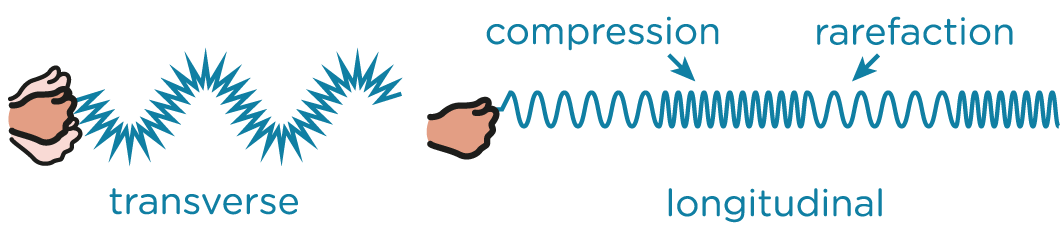
- Transverse waves are caused by vibrations that are perpendicular to their energy transfer. Examples of transverse waves are light and water ripples.
- Longitudinal waves are caused by vibrations that are parallel to the direction of energy transfer.
- Longitudinal waves consist of compressions, where matter is pushed together, and rarefactions, where it is pulled apart.
- Sound is an example of a longitudinal wave. It is produced by a vibrating object and travels through air by creating compressions and rarefactions in it.
Unlock Transverse and longitudinal waves
Subscribe to SnapRevise+ to get immediate access to the rest of this resource.
Premium accounts get immediate access to this resource.