

Topic Summaries
States of matter
Energy and power
Renewable energy and efficiency
Charge, current, and electric fields
Potential difference and resistors
Electricity
Volume and gases
States of matter and heat capacity
Radiation
Nuclear fusion and fission
Forces
Velocity and acceleration
Gravity and Newton's Laws
Moments and elastic potential
Stopping, braking, and momentum
Properties of waves
Electromagnetic waves
Refraction and lenses
Light, colour, and ray diagrams
Absorbing and emitting infrared radiation
Magnetic fields
Motor effect, generator effect, and transformers
Science skills: Experimental procedures
Science skills: Presenting and using data
Science skills: Measuring results
Energy and power
Renewable energy and efficiency
Charge, current, and electric fields
Potential difference and resistors
Electricity
Volume and gases
States of matter and heat capacity
Radiation
Nuclear fusion and fission
Forces
Velocity and acceleration
Gravity and Newton's Laws
Moments and elastic potential
Stopping, braking, and momentum
Properties of waves
Electromagnetic waves
Refraction and lenses
Light, colour, and ray diagrams
Absorbing and emitting infrared radiation
Magnetic fields
Motor effect, generator effect, and transformers
Science skills: Experimental procedures
Science skills: Presenting and using data
Science skills: Measuring results
- The different states of matter can be explained using particle models of atoms and molecules.
- In a solid, the particles are all tightly packed in a rigid structure. They cannot move because of strong intermolecular forces but they can vibrate.
- In a liquid, these forces are slightly weaker. The particles stay in contact but they can move and flow. The liquid can change shape to fit a container.
- In a gas, the particles can freely move. They are spread out so the gas expands to fill any volume, and the forces between particles are very small.
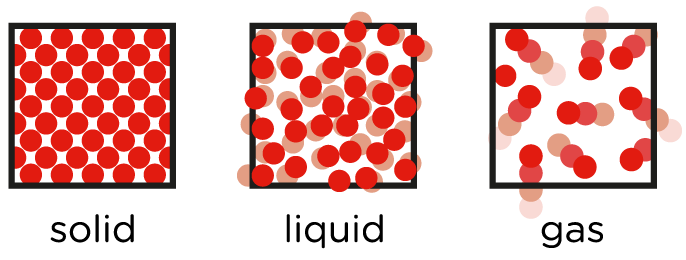
- Solids and liquids have high densities as atoms are tightly packed together. In gases, the density is much lower as the atoms or molecules are spread out.
- Substances can change state through various processes.
- During these, mass is conserved as the number of particles doesn’t change.
- These are physical processes because they are reversible and the substance does not change.
| Process | Change from... | To... |
| Melting | Solid | Liquid |
| Freezing | Liquid | Solid |
| Boiling/evaporating | Liquid | Gas |
| Condensation | Gas | Liquid |
| Sublimation | Solid | Gas |
Unlock States of matter
Subscribe to SnapRevise+ to get immediate access to the rest of this resource.
Premium accounts get immediate access to this resource.