

Topic Summaries
Temperature change and radiation (HT ONLY)
Energy and power
Renewable energy and efficiency
Charge, current, and electric fields
Potential difference and resistors
Electricity
Volume and gases
States of matter and heat capacity
Radiation
Nuclear fusion and fission
Forces
Velocity and acceleration
Gravity and Newton's Laws
Moments and elastic potential
Pressure
Stopping, braking, and momentum
Properties of waves
Electromagnetic waves
Refraction and lenses
Light, colour, and ray diagrams
Absorbing and emitting infrared radiation
Magnetic fields
Motor effect, generator effect, and transformers
Science skills: Experimental procedures
Science skills: Presenting and using data
Science skills: Measuring results
Energy and power
Renewable energy and efficiency
Charge, current, and electric fields
Potential difference and resistors
Electricity
Volume and gases
States of matter and heat capacity
Radiation
Nuclear fusion and fission
Forces
Velocity and acceleration
Gravity and Newton's Laws
Moments and elastic potential
Pressure
Stopping, braking, and momentum
Properties of waves
Electromagnetic waves
Refraction and lenses
Light, colour, and ray diagrams
Absorbing and emitting infrared radiation
Magnetic fields
Motor effect, generator effect, and transformers
Science skills: Experimental procedures
Science skills: Presenting and using data
Science skills: Measuring results
- If an object is at a constant temperature, then it is absorbing and emitting radiation at the same rate:
- If it absorbs radiation faster than it can emit, then its temperature is rising, such as with an ice cube in a warm room.
- If it emits radiation faster than it can absorb, then its temperature is decreasing, such as with a lump of hot coal in a cool room.
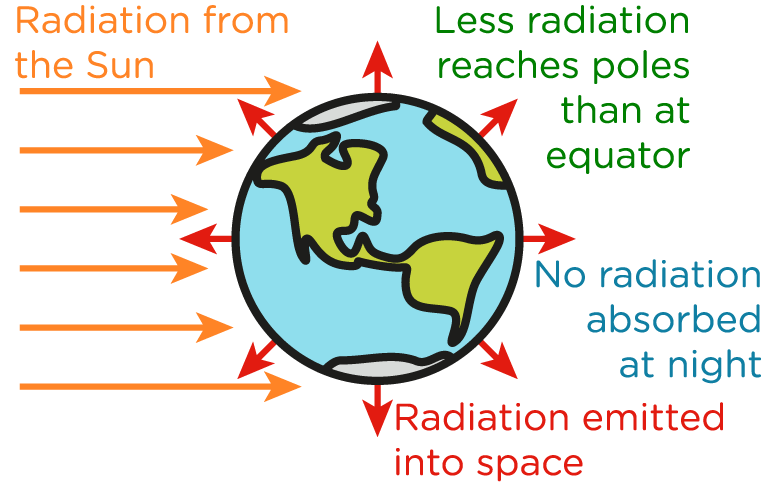
- The temperature of the Earth depends on how it absorbs radiation from the sun and re-emits it into space.
- One side of Earth is facing the Sun, so it absorbs a lot of radiation. The other side faces away from the Sun, so it doesn’t absorb any radiation but is still emitting it. So, the Earth’s surface warms up during the day and cools at night.
- Less radiation is incident to the Earth at its poles than on the equator. This is why the equator is very hot and the poles are very cold.
Unlock Temperature change and radiation (HT ONLY)
Subscribe to SnapRevise+ to get immediate access to the rest of this resource.
Premium accounts get immediate access to this resource.