

Topic Summaries
Acceleration due to gravity and terminal velocity
Energy and power
Renewable energy and efficiency
Charge, current, and electric fields
Potential difference and resistors
Electricity
Volume and gases
States of matter and heat capacity
Radiation
Nuclear fusion and fission
Forces
Velocity and acceleration
Gravity and Newton's Laws
Moments and elastic potential
Pressure
Stopping, braking, and momentum
Properties of waves
Electromagnetic waves
Refraction and lenses
Light, colour, and ray diagrams
Absorbing and emitting infrared radiation
Magnetic fields
Motor effect, generator effect, and transformers
Science skills: Experimental procedures
Science skills: Presenting and using data
Science skills: Measuring results
Energy and power
Renewable energy and efficiency
Charge, current, and electric fields
Potential difference and resistors
Electricity
Volume and gases
States of matter and heat capacity
Radiation
Nuclear fusion and fission
Forces
Velocity and acceleration
Gravity and Newton's Laws
Moments and elastic potential
Pressure
Stopping, braking, and momentum
Properties of waves
Electromagnetic waves
Refraction and lenses
Light, colour, and ray diagrams
Absorbing and emitting infrared radiation
Magnetic fields
Motor effect, generator effect, and transformers
Science skills: Experimental procedures
Science skills: Presenting and using data
Science skills: Measuring results
- Any object that is falling, with the only force affecting it being gravity, will have an acceleration of 9.8 m/s2.
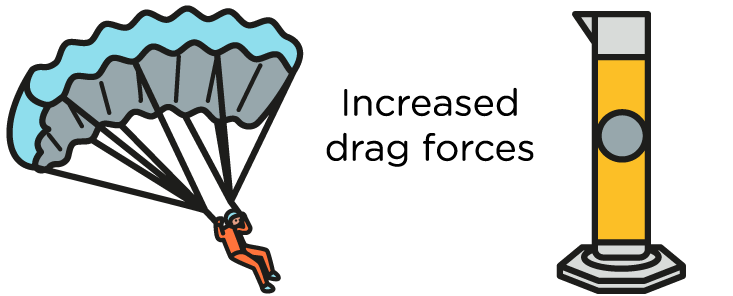
- When an object is falling through a fluid, it will initially accelerate downwards because of gravity. This motion will cause air resistance or drag forces to affect it. Eventually, the drag forces will equal the gravitational force and the object will stop accelerating. The constant speed it now travels at is its terminal velocity.
- The terminal velocity and the time it takes to reach it can be decreased by increasing the surface area of the object, such as by using a parachute, or increasing the thickness of the fluid, such as by falling in water rather than air.
- For example, as a parachutist falls through the air:
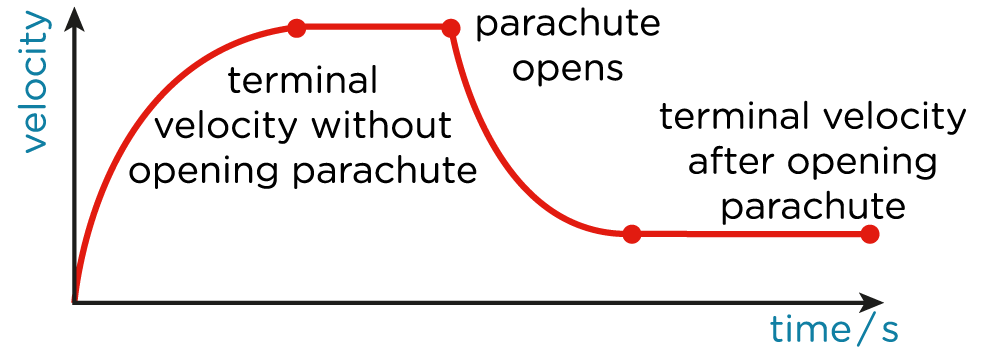
- Their downward velocity will first increase rapidly due to acceleration by gravity.
- As air resistance starts to affect them, this acceleration will start to decrease. However, their velocity is still increasing as their weight is greater than drag forces.
- The air resistance will increase with their speed, to a point where it is equal to their weight. The parachutist now falls at a constant terminal velocity.
- When the parachutist opens the parachute, the increase in surface area causes a sudden increase in air resistance and decelerates.
- Eventually, air resistance decreases to match weight again, and the parachutist falls at a slower terminal velocity.
Unlock Acceleration due to gravity and terminal velocity
Subscribe to SnapRevise+ to get immediate access to the rest of this resource.
Premium accounts get immediate access to this resource.