

Topic Summaries
Transformers (HT ONLY)
Energy and power
Renewable energy and efficiency
Charge, current, and electric fields
Potential difference and resistors
Electricity
Volume and gases
States of matter and heat capacity
Radiation
Nuclear fusion and fission
Forces
Velocity and acceleration
Gravity and Newton's Laws
Moments and elastic potential
Stopping, braking, and momentum
Properties of waves
Electromagnetic waves
Refraction and lenses
Light, colour, and ray diagrams
Absorbing and emitting infrared radiation
Magnetic fields
Motor effect, generator effect, and transformers
Science skills: Experimental procedures
Science skills: Presenting and using data
Science skills: Measuring results
Energy and power
Renewable energy and efficiency
Charge, current, and electric fields
Potential difference and resistors
Electricity
Volume and gases
States of matter and heat capacity
Radiation
Nuclear fusion and fission
Forces
Velocity and acceleration
Gravity and Newton's Laws
Moments and elastic potential
Stopping, braking, and momentum
Properties of waves
Electromagnetic waves
Refraction and lenses
Light, colour, and ray diagrams
Absorbing and emitting infrared radiation
Magnetic fields
Motor effect, generator effect, and transformers
Science skills: Experimental procedures
Science skills: Presenting and using data
Science skills: Measuring results
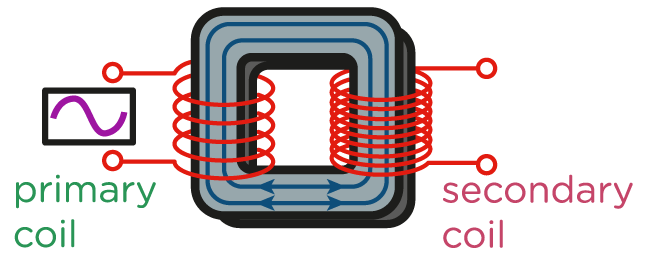
- A transformer consists of two coils wrapped around an iron core. When an alternating current flows through one coil, it induces a magnetic field around it.
- This magnetic field is periodically changing direction and is concentrated by the iron core, so it induces an alternating current in the other coil.
- An iron core is used as it is easily magnetised.
- Transformers are used to change an alternating potential difference.
- Step-up transformers increase potential difference by having more turns on their secondary coils.
- Step-down transformers decrease potential difference by having more turns on their primary coils.
- The transformer equation states that the ratio of potential differences and turns in the coils of a transformer are equal: \(\dfrac{V_p}{V_s}=\dfrac{n_p}{n_s}\) where \(V_p\) and \(V_s\) are the potential differences in the primary and secondary coils respectively in V, and \(n_p\) and \(n_s\) are the number of turns in the primary and secondary coils respectively.
- If a transformer is 100% efficient, then there are no energy losses and the input power to the primary coil is equal to the output power from the secondary coil. This can be written as \(V_s\times I_s = V_p\times I_p\).
Unlock Transformers (HT ONLY)
Subscribe to SnapRevise+ to get immediate access to the rest of this resource.
Premium accounts get immediate access to this resource.