

Topic Summaries
Errors and anomalies
Energy and power
Renewable energy and efficiency
Charge, current, and electric fields
Potential difference and resistors
Electricity
Volume and gases
States of matter and heat capacity
Radiation
Nuclear fusion and fission
Forces
Velocity and acceleration
Gravity and Newton's Laws
Moments and elastic potential
Stopping, braking, and momentum
Properties of waves
Electromagnetic waves
Refraction and lenses
Light, colour, and ray diagrams
Absorbing and emitting infrared radiation
Magnetic fields
Motor effect, generator effect, and transformers
Science skills: Experimental procedures
Science skills: Presenting and using data
Science skills: Measuring results
Energy and power
Renewable energy and efficiency
Charge, current, and electric fields
Potential difference and resistors
Electricity
Volume and gases
States of matter and heat capacity
Radiation
Nuclear fusion and fission
Forces
Velocity and acceleration
Gravity and Newton's Laws
Moments and elastic potential
Stopping, braking, and momentum
Properties of waves
Electromagnetic waves
Refraction and lenses
Light, colour, and ray diagrams
Absorbing and emitting infrared radiation
Magnetic fields
Motor effect, generator effect, and transformers
Science skills: Experimental procedures
Science skills: Presenting and using data
Science skills: Measuring results
- Errors will cause data to differ from the true value. Random errors or anomalies affect single experiments and vary unpredictably, reducing the precision of the experiment.
- Systematic errors involve measurement results differing from the true value by a consistent amount each time. This will reduce accuracy.
- Anomalies should be identified and omitted from the results. This can be done by:
- Repeating experiments to find values that do not match others. For example, in the measurements 3, 7, 25, and 8, taken under the same conditions, the value 25 would be an anomaly.
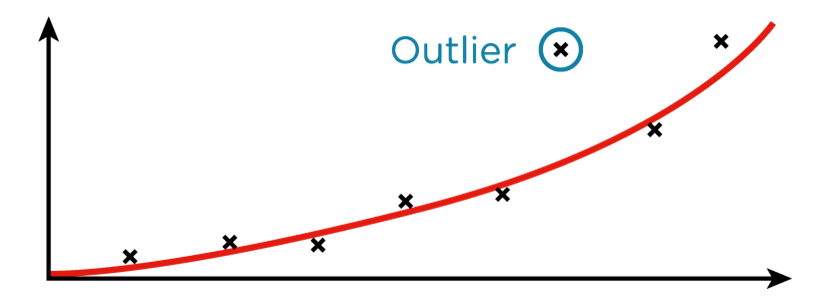
- Plotting results and seeing which values would not fit the pattern established by the rest of the data.
- Systematic errors can be prevented through careful planning of experiments. This includes:
- Ensuring all control variables remain unchanged during the experiment.
- Calibrating all equipment and using it correctly.
- Turning off equipment between measurements to prevent heating if temperature is a variable.
- Testing equipment before an experiment.
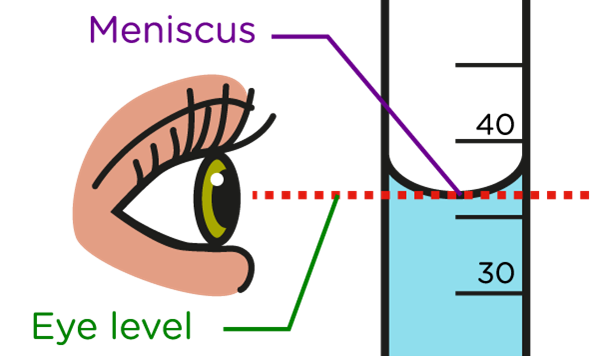
- Only measuring the meniscus at eye level when using a measuring cylinder.
Unlock Errors and anomalies
Subscribe to SnapRevise+ to get immediate access to the rest of this resource.
Premium accounts get immediate access to this resource.