

Topic Summaries
Geological landforms resulting from deposition
Natural and tectonic hazards
Earth layers and earthquakes
Tectonic plate margins
Responses to tectonic hazards
Risks of tectonic hazards
Weather hazards and atmospheric circulation
Tropical storm hazards
Responding to tropical storms
Climate change
Components and characteristics of ecosystems
Tropical rainforest ecosystems
Hot desert ecosystems
Cold environment ecosystems
Coastal landscapes
Coastal landform processes
Management strategies for coastal landscapes
River landscapes
Fluvial landform processes
Management strategies for floods
Glacial landscapes
Glacial landform processes
Patterns of urban change
Urban sustainability and patterns of urban development
Global development gap and global aid
Rapid economic development
Economic changes in the UK
Resource management
Food supply
Food supply and water supply
Water supply
Natural and tectonic hazards
Earth layers and earthquakes
Tectonic plate margins
Responses to tectonic hazards
Risks of tectonic hazards
Weather hazards and atmospheric circulation
Tropical storm hazards
Responding to tropical storms
Climate change
Components and characteristics of ecosystems
Tropical rainforest ecosystems
Hot desert ecosystems
Cold environment ecosystems
Coastal landscapes
Coastal landform processes
Management strategies for coastal landscapes
River landscapes
Fluvial landform processes
Management strategies for floods
Glacial landscapes
Glacial landform processes
Patterns of urban change
Urban sustainability and patterns of urban development
Global development gap and global aid
Rapid economic development
Economic changes in the UK
Resource management
Food supply
Food supply and water supply
Water supply
- Beaches:
- Constructive waves deposit sand or shingle along the coastline.
- Sand beaches: found in sheltered areas with low-energy waves.
- Shingle beaches: found in areas with high-energy waves, where sand is washed away, leaving behind pebbles.
- Example: the south coast of England has pebble beaches due to destructive waves removing sand.
- Sand dunes:
- Embryo dunes: forms near the sea when sand is deposited and trapped by obstacles like vegetation.
- Growth: marram grass and other vegetation grow on dunes, stabilising dunes with their long roots.
- Organic matter: decaying vegetation adds nutrients to the sand, allowing more plants to colonise.
- Mature dunes: older dunes, further from the sea, may support shrubs and trees.
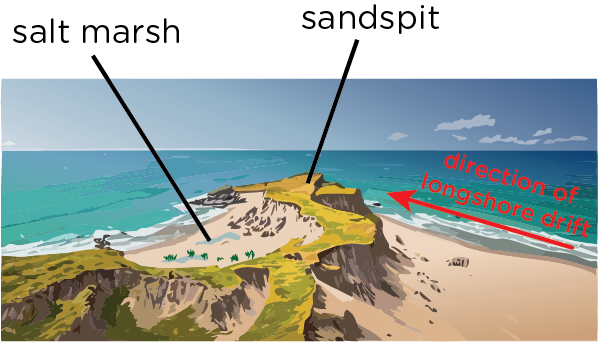
- Spits:
- Longshore drift: sediment is transported along the coast by longshore drift.
- Change in coastline: when the coastline changes direction (e.g. at a river mouth), sediment is deposited, forming a spit.
- Extension: the spit extends out into the sea, with longshore drift continuing to deposit material.
- Hooked end: strong winds and wave action curve the end of the spit, forming a hooked end.
- Salt marsh: sheltered water behind the spit allows salt marshes to form, creating ideal habitats for wildlife (e.g. Dawlish Warren Spit, Devon).
- Bars:
- A bar forms when longshore drift continues depositing sediment across a bay, connecting two headlands.
- This creates a ridge of sand or shingle that blocks off the bay, forming a lagoon behind it. (e.g. Slapton Sands Bar, Devon).
Unlock Geological landforms resulting from deposition
Subscribe to SnapRevise+ to get immediate access to the rest of this resource.
Premium accounts get immediate access to this resource.