

Topic Summaries
Presenting data
Energy and power
Renewable energy and efficiency
Charge, current, and electric fields
Potential difference and resistors
Electricity
Volume and gases
States of matter and heat capacity
Radiation
Nuclear fusion and fission
Forces
Velocity and acceleration
Gravity and Newton's Laws
Moments and elastic potential
Stopping, braking, and momentum
Properties of waves
Electromagnetic waves
Refraction and lenses
Light, colour, and ray diagrams
Absorbing and emitting infrared radiation
Magnetic fields
Motor effect, generator effect, and transformers
Science skills: Experimental procedures
Science skills: Presenting and using data
Science skills: Measuring results
Energy and power
Renewable energy and efficiency
Charge, current, and electric fields
Potential difference and resistors
Electricity
Volume and gases
States of matter and heat capacity
Radiation
Nuclear fusion and fission
Forces
Velocity and acceleration
Gravity and Newton's Laws
Moments and elastic potential
Stopping, braking, and momentum
Properties of waves
Electromagnetic waves
Refraction and lenses
Light, colour, and ray diagrams
Absorbing and emitting infrared radiation
Magnetic fields
Motor effect, generator effect, and transformers
Science skills: Experimental procedures
Science skills: Presenting and using data
Science skills: Measuring results
- Frequency tables are used to record results from experiments. The first column should be the independent variable, and headers should include units.
| Example frequency table | |||||
| Indepedent variable, 𝒳 (s) | Measured variable, y (m) | Calculated dependent variable, y² (m²) | |||
| 1 | 2 | 3 | Mean | ||
| 1 | 1.2 | 1.4 | 1.3 | 1.3 | 1.7 |
| 2 | 2.8 | 2.6 | 3 | 2.8 | 7.8 |
| 3 | 3.7 | 3.2 | 3.8 | 3.6 | 12.7 |
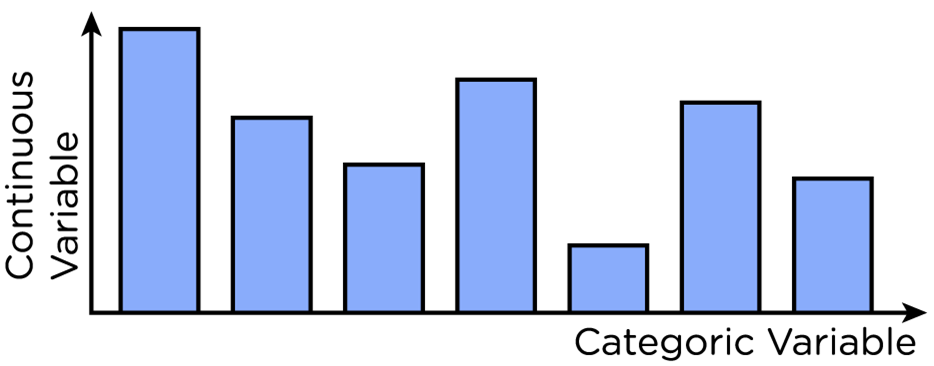
- Bar charts are used to compare categoric variables to continuous variables.
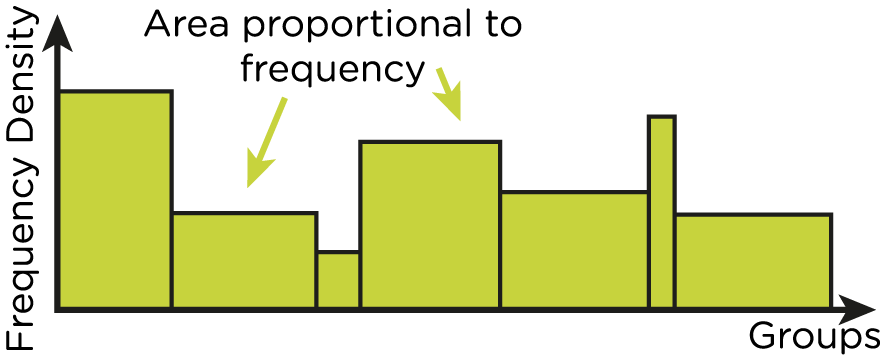
- Histograms show how a set of continuous data fits into grouped categories.
- The height of each bar represents the frequency density.
- The area of each bar is proportional to the number of data values in the group.
- The bars should all be touching.
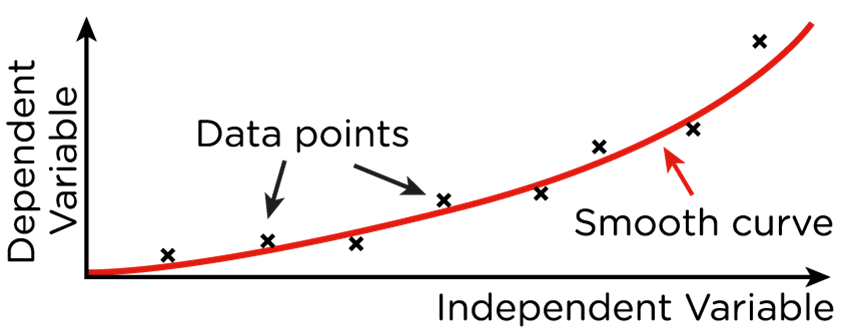
- Line graphs compare two continuous variables.
- Recorded data is plotted onto a graph. The x and y coordinates of each point correspond to a value for the independent and dependent variable, respectively.
- A smooth curve is drawn to show the general relationship. This should be close to as many points as possible, excluding outliers.
Unlock Presenting data
Subscribe to SnapRevise+ to get immediate access to the rest of this resource.
Premium accounts get immediate access to this resource.