

Topic Summaries
Gravity and calculating weight
Energy and power
Renewable energy and efficiency
Charge, current, and electric fields
Potential difference and resistors
Electricity
Volume and gases
States of matter and heat capacity
Radiation
Nuclear fusion and fission
Forces
Velocity and acceleration
Gravity and Newton's Laws
Moments and elastic potential
Pressure
Stopping, braking, and momentum
Properties of waves
Electromagnetic waves
Refraction and lenses
Light, colour, and ray diagrams
Absorbing and emitting infrared radiation
Magnetic fields
Motor effect, generator effect, and transformers
Science skills: Experimental procedures
Science skills: Presenting and using data
Science skills: Measuring results
Energy and power
Renewable energy and efficiency
Charge, current, and electric fields
Potential difference and resistors
Electricity
Volume and gases
States of matter and heat capacity
Radiation
Nuclear fusion and fission
Forces
Velocity and acceleration
Gravity and Newton's Laws
Moments and elastic potential
Pressure
Stopping, braking, and momentum
Properties of waves
Electromagnetic waves
Refraction and lenses
Light, colour, and ray diagrams
Absorbing and emitting infrared radiation
Magnetic fields
Motor effect, generator effect, and transformers
Science skills: Experimental procedures
Science skills: Presenting and using data
Science skills: Measuring results
- Large objects, such as the Earth, will produce a gravitational field. Masses inside the gravitational field will experience a force called weight.
- Weight will pull the mass towards the centre of the field. On Earth, this will pull masses down toward its surface.
- Weight will act through a single point in the object called its centre of mass. Smaller objects also produce gravitational fields, but the forces from these are too small to be noticed.
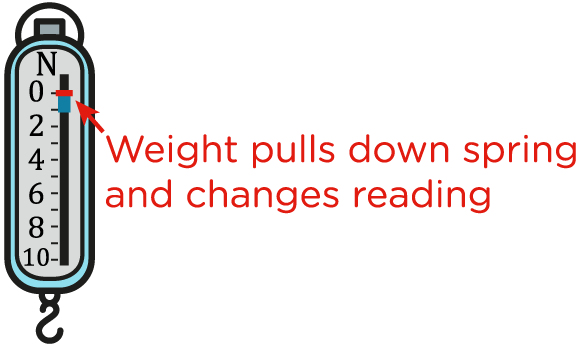
- The weight of an object can be measured using a spring balance.
- The weight an object experiences depends on its mass and gravitational field strength, given by \(\text{weight}=\text{mass}\times\text{gravitational field strength}\) or \(W = mg\)
- Mass is how much matter makes up an object. An object’s mass will be the same in any gravitational field at any point in the universe.
- Gravitational field strength is the force a 1 kg object would experience at a point in a gravitational field, given in N/kg. This will depend on location in the field and what is producing the field.
- On the Earth’s surface, the gravitational field strength has a constant value of 9.8 N/kg.This means that on Earth, mass is proportional to weight. However, on other planets, the weight of an object will change while its mass will not.
Unlock Gravity and calculating weight
Subscribe to SnapRevise+ to get immediate access to the rest of this resource.
Premium accounts get immediate access to this resource.