

Topic Summaries
Half-lives
Energy and power
Renewable energy and efficiency
Charge, current, and electric fields
Potential difference and resistors
Electricity
Volume and gases
States of matter and heat capacity
Radiation
Nuclear fusion and fission
Forces
Velocity and acceleration
Gravity and Newton's Laws
Moments and elastic potential
Pressure
Stopping, braking, and momentum
Properties of waves
Electromagnetic waves
Refraction and lenses
Light, colour, and ray diagrams
Absorbing and emitting infrared radiation
Magnetic fields
Motor effect, generator effect, and transformers
Science skills: Experimental procedures
Science skills: Presenting and using data
Science skills: Measuring results
Energy and power
Renewable energy and efficiency
Charge, current, and electric fields
Potential difference and resistors
Electricity
Volume and gases
States of matter and heat capacity
Radiation
Nuclear fusion and fission
Forces
Velocity and acceleration
Gravity and Newton's Laws
Moments and elastic potential
Pressure
Stopping, braking, and momentum
Properties of waves
Electromagnetic waves
Refraction and lenses
Light, colour, and ray diagrams
Absorbing and emitting infrared radiation
Magnetic fields
Motor effect, generator effect, and transformers
Science skills: Experimental procedures
Science skills: Presenting and using data
Science skills: Measuring results
- Radioactive decay is a random process, meaning it is impossible to predict which nuclei in a radioactive sample will decay next or when.
- Radioactive decay is unaffected by external physical conditions, such as temperature. Each nucleus has an equal chance of being the next to decay.
- For a large number of radioactive nuclei, it can be calculated what proportion of nuclei will decay in a period of time.
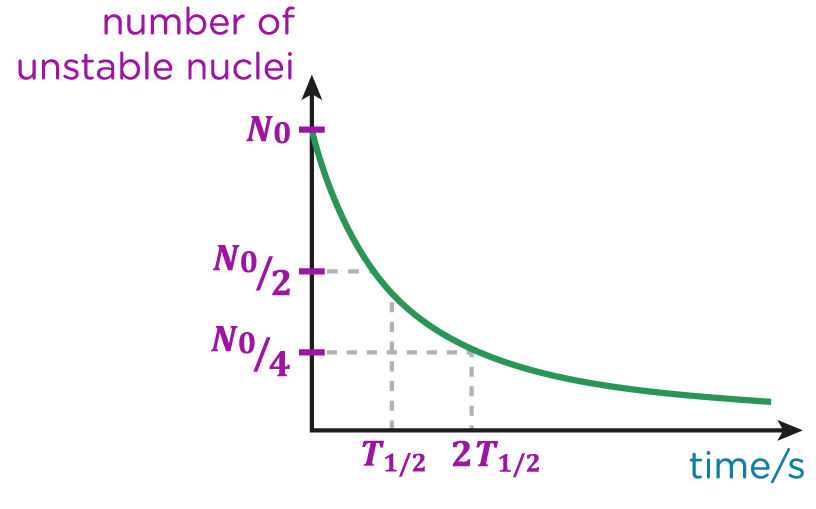
- The half-life, \(t_{1/2}\), of a radioactive isotope is the time it takes half the nuclei in a sample of that isotope to decay.
- This will also be the time it takes the activity of the sample to halve.
- Half-life will be the same for any sized sample and throughout its decay.
- After n half-lives, the number of undecayed nuclei will be \(\frac{1}{2^n}\) of its initial value.
- Half-life is a property determined by the isotope of a nucleus. The shorter the half-life, the faster an isotope will decay.
Unlock Half-lives
Subscribe to SnapRevise+ to get immediate access to the rest of this resource.
Premium accounts get immediate access to this resource.