

Topic Summaries
The generator effect (HT ONLY)
Energy and power
Renewable energy and efficiency
Charge, current, and electric fields
Potential difference and resistors
Electricity
Volume and gases
States of matter and heat capacity
Radiation
Nuclear fusion and fission
Forces
Velocity and acceleration
Gravity and Newton's Laws
Moments and elastic potential
Pressure
Stopping, braking, and momentum
Properties of waves
Electromagnetic waves
Refraction and lenses
Light, colour, and ray diagrams
Absorbing and emitting infrared radiation
Magnetic fields
Motor effect, generator effect, and transformers
Science skills: Experimental procedures
Science skills: Presenting and using data
Science skills: Measuring results
Energy and power
Renewable energy and efficiency
Charge, current, and electric fields
Potential difference and resistors
Electricity
Volume and gases
States of matter and heat capacity
Radiation
Nuclear fusion and fission
Forces
Velocity and acceleration
Gravity and Newton's Laws
Moments and elastic potential
Pressure
Stopping, braking, and momentum
Properties of waves
Electromagnetic waves
Refraction and lenses
Light, colour, and ray diagrams
Absorbing and emitting infrared radiation
Magnetic fields
Motor effect, generator effect, and transformers
Science skills: Experimental procedures
Science skills: Presenting and using data
Science skills: Measuring results
- A potential difference is induced in a conductor when it moves relative to a magnetic field or there is a change in the field. A current is induced if the conductor is connected to a complete circuit. This field opposes the change causing the generator effect and is the main method of generating electricity.
- Reversing the motion of the conductor or the polarity of the field reverses the direction of the potential difference.
- The size of an induced potential difference can be increased by increasing the speed of motion of the conductor or rate of change of the field, using a stronger magnetic field, or using a longer length of conductor or coiling it.
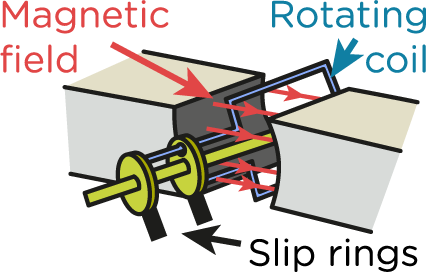
- An alternator uses the generator effect to produce an alternating current when a coil turns in a magnetic field, inducing a potential difference in it. The coil connects to a circuit using a pair of slip rings, inducing a current.
- The strength and direction of the current vary with time. It will be strongest when the coil is perpendicular to the field. Increasing speed of rotation increases peak potential difference and frequency.
- A dynamo functions similarly to an alternator but uses a slip ring communicator instead of a pair of slip rings. So, it will instead produce a varying direct current.
- Microphones contain a coil that vibrates around a magnet when sound waves are directed at it. This generates a current that converts the sound waves to an electrical signal. This signal can be sent to a loudspeaker to project the sound.
Unlock The generator effect (HT ONLY)
Subscribe to SnapRevise+ to get immediate access to the rest of this resource.
Premium accounts get immediate access to this resource.