

Topic Summaries
Refraction
Energy and power
Renewable energy and efficiency
Charge, current, and electric fields
Potential difference and resistors
Electricity
Volume and gases
States of matter and heat capacity
Radiation
Nuclear fusion and fission
Forces
Velocity and acceleration
Gravity and Newton's Laws
Moments and elastic potential
Pressure
Stopping, braking, and momentum
Properties of waves
Electromagnetic waves
Refraction and lenses
Light, colour, and ray diagrams
Absorbing and emitting infrared radiation
Magnetic fields
Motor effect, generator effect, and transformers
Science skills: Experimental procedures
Science skills: Presenting and using data
Science skills: Measuring results
Energy and power
Renewable energy and efficiency
Charge, current, and electric fields
Potential difference and resistors
Electricity
Volume and gases
States of matter and heat capacity
Radiation
Nuclear fusion and fission
Forces
Velocity and acceleration
Gravity and Newton's Laws
Moments and elastic potential
Pressure
Stopping, braking, and momentum
Properties of waves
Electromagnetic waves
Refraction and lenses
Light, colour, and ray diagrams
Absorbing and emitting infrared radiation
Magnetic fields
Motor effect, generator effect, and transformers
Science skills: Experimental procedures
Science skills: Presenting and using data
Science skills: Measuring results
- When an electromagnetic wave meets a surface, it can be:
- Transmitted, causing the wave to pass through.
- Absorbed, causing the wave to be stopped at the boundary.
- Reflected, causing the wave to be redirected away from the boundary.
- The behaviour of the wave depends on its wavelength and the surface it is meeting.
- Surfaces appear certain colours because those are the wavelengths of visible light that are reflected off them. All other colours are absorbed.
- Metals reflect most waves but short wavelength waves, such as gamma waves, will pass through.
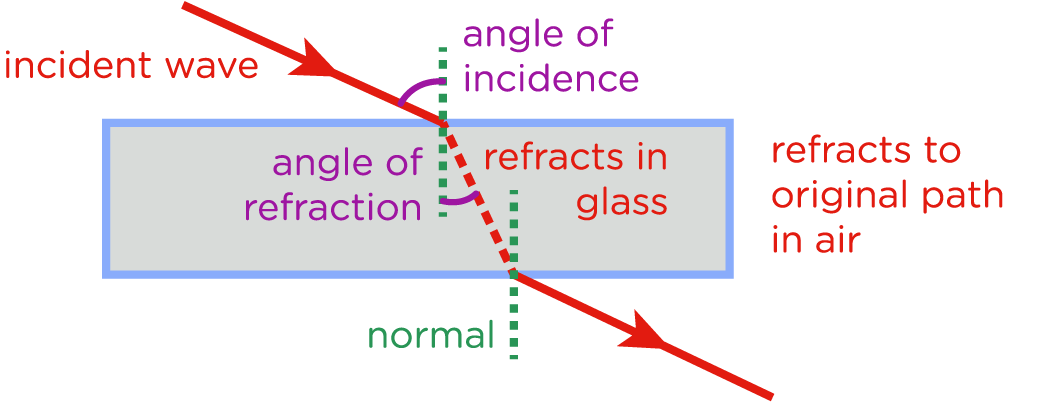
- Electromagnetic waves will change direction when transmitting into a different medium at an angle. This is called refraction.
- Refraction can be shown on a ray diagram. A ray is a thin beam of electromagnetic waves, such as visible light.
- The angle at which the ray enters a boundary is the angle of incidence. The angle at which it leaves is the angle of refraction. Both angles are measured against the normal, a line at 90° to the surface.
Unlock Refraction
Subscribe to SnapRevise+ to get immediate access to the rest of this resource.
Premium accounts get immediate access to this resource.