

Topic Summaries
The motor effect (HT ONLY)
Energy and power
Renewable energy and efficiency
Charge, current, and electric fields
Potential difference and resistors
Electricity
Volume and gases
States of matter and heat capacity
Radiation
Nuclear fusion and fission
Forces
Velocity and acceleration
Gravity and Newton's Laws
Moments and elastic potential
Pressure
Stopping, braking, and momentum
Properties of waves
Electromagnetic waves
Refraction and lenses
Light, colour, and ray diagrams
Absorbing and emitting infrared radiation
Magnetic fields
Motor effect, generator effect, and transformers
Science skills: Experimental procedures
Science skills: Presenting and using data
Science skills: Measuring results
Energy and power
Renewable energy and efficiency
Charge, current, and electric fields
Potential difference and resistors
Electricity
Volume and gases
States of matter and heat capacity
Radiation
Nuclear fusion and fission
Forces
Velocity and acceleration
Gravity and Newton's Laws
Moments and elastic potential
Pressure
Stopping, braking, and momentum
Properties of waves
Electromagnetic waves
Refraction and lenses
Light, colour, and ray diagrams
Absorbing and emitting infrared radiation
Magnetic fields
Motor effect, generator effect, and transformers
Science skills: Experimental procedures
Science skills: Presenting and using data
Science skills: Measuring results
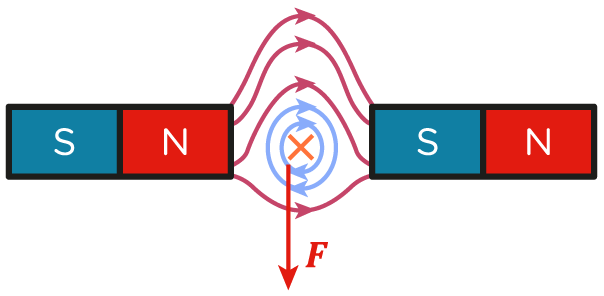
- The motor effect is when a conductor carrying a current through a magnetic field experiences a force from the magnet and conductor fields squashing against each other.
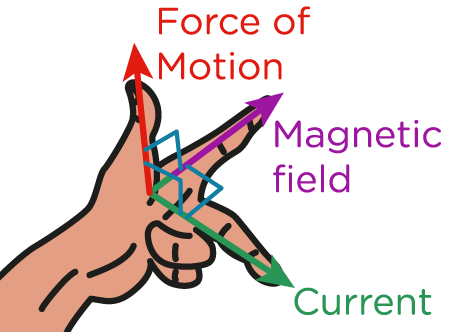
- The direction of the force on a wire can be determined using Fleming’s Left-Hand Rule.This is done by holding your thumb, first finger and second finger out at right angles to each other with your first finger should point in the direction of the field, and your second finger should point in the direction of the current in the wire. Your thumb will then point in the direction of the force.
- The magnitude of the force on a wire at right angles to the field is given by \(\text{force}=\text{magnetic flux density}\times\text{current}\times\text{length}\).
- Magnetic flux density is a measure of a magnetic field’s strength or how close together its field lines are. It is measured in Tesla, T.
- This equation can also be written as \(F=BIL\) where \(F\) is the force the wire experiences in N, \(B\) is the magnetic flux density of the field in T, \(I\) is the current in the wire in A, and \(L\) is the length of the wire within the field in m.
Unlock The motor effect (HT ONLY)
Subscribe to SnapRevise+ to get immediate access to the rest of this resource.
Premium accounts get immediate access to this resource.