

Topic Summaries
The Humanistic approach .
A-Level
>
Psychology
>
AQA
>
A-Level Psychology Topic Summaries
>
Approaches in psychology
>
The Humanistic approach .
Social influence
Memory
Attachment
Approaches in psychology
Biopsychology
Clinical psychology and mental health
Research methods
Issues and debates
Relationships
Gender
Cognition and development
Schizophrenia
Stress
Eating behaviour
Aggression
Forensic psychology
Social influence
Memory
Attachment
Approaches in psychology
Biopsychology
Clinical psychology and mental health
Research methods
Issues and debates
Relationships
Gender
Cognition and development
Schizophrenia
Stress
Eating behaviour
Aggression
Forensic psychology
- Developed by 👥 Maslow and Rogers (1943), the humanistic approach emphasises the importance of personal growth and fulfilment, focusing on personal responsibility.
- It is less scientific but observes the individual as a whole, including their emotions, feelings, motivations, etc.
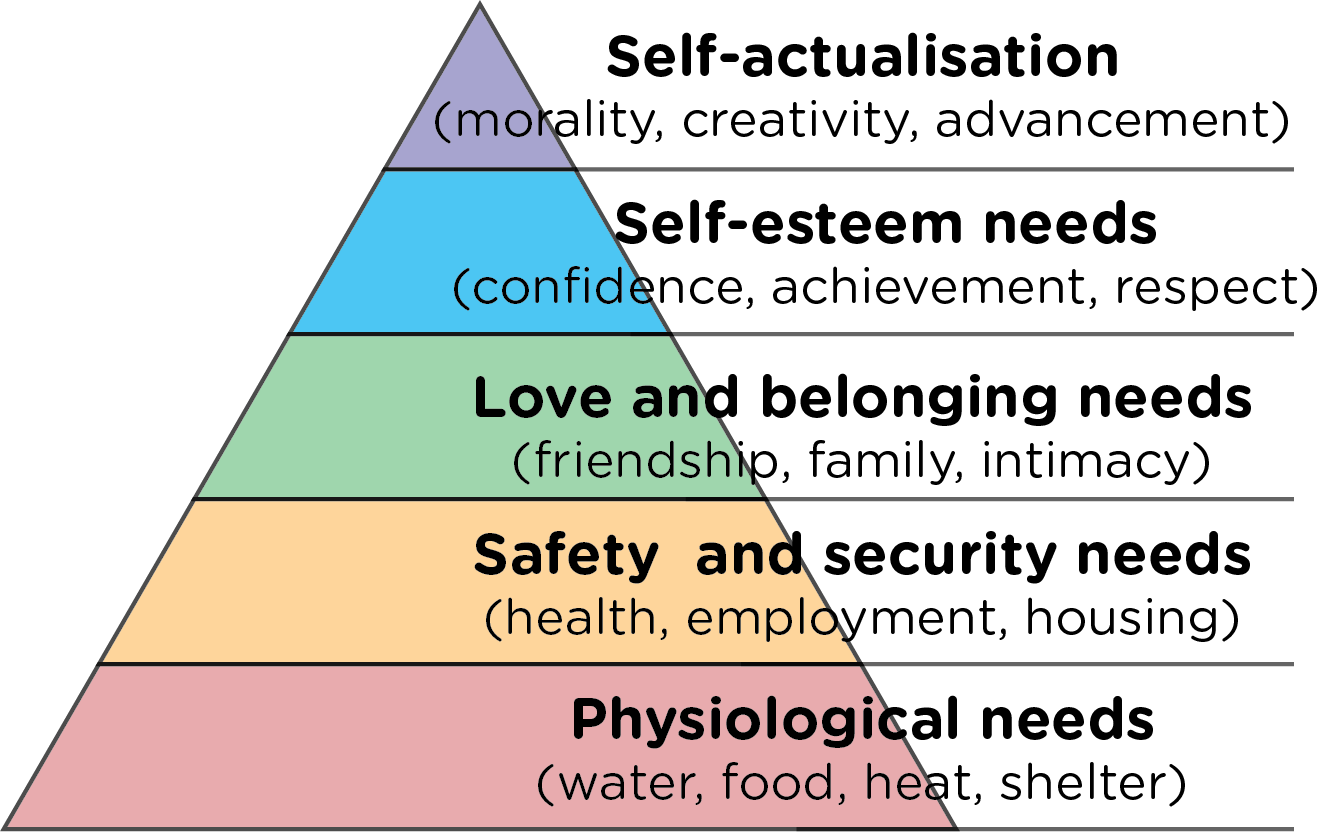
- Key principles include self-actualisation and the hierarchy of needs:
- Maslow claimed that people have a hierarchy of needs, and in order for one to be addressed, another must first be accomplished.
- Self-actualisation is the most rewarding human need. When people have self-actualised, they have no anxiety; they are creative, constantly happy, and feel at peace with themselves.
- Rogers argued that for personal growth to be accomplished, an individual must seek congruence. This is when their self and ideal self are aligned which gives them a feeling of self-worth.
- He believed that our feelings around self-worth and self-acceptance are based on our interactions with others, specifically our parents.
- If these people have high expectations of us (conditions of worth) that we cannot to live up to in order to gain positive regard or achieve acceptance, then we develop incongruence which stops us from reaching self-actualisation.
- Free will: promotes the idea that we all have autonomy and can choose our own life/destiny.
- Abstract ideas: the humanistic approach is based on largely abstract and unfalsifiable ideas. The subjective ideas of ‘congruence’ and ‘self-actualisation’ cannot be proven and therefore lack scientific credibility.
- Little real world application: despite counselling techniques being developed from this idea, there is minimal other applications for us in real-world situations
Unlock The Humanistic approach .
Subscribe to SnapRevise+ to get immediate access to the rest of this resource.
Premium accounts get immediate access to this resource.