

Topic Summaries
Asch’s research into conformity
A-Level
>
Psychology
>
AQA
>
A-Level Psychology Topic Summaries
>
Social influence
>
Asch’s research into conformity
Social influence
Memory
Attachment
Approaches in psychology
Biopsychology
Clinical psychology and mental health
Research methods
Issues and debates
Relationships
Gender
Cognition and development
Schizophrenia
Stress
Eating behaviour
Aggression
Forensic psychology
Social influence
Memory
Attachment
Approaches in psychology
Biopsychology
Clinical psychology and mental health
Research methods
Issues and debates
Relationships
Gender
Cognition and development
Schizophrenia
Stress
Eating behaviour
Aggression
Forensic psychology
- Aim: Asch conducted a lab experiment which examined conformity by testing the extent to which people will conform to the opinion of others, even in a situation where the answer is clear.
- Participants: 123 male American college students; each participant took part in 18 trials. In the first four, the confederates gave the correct answers, and then slowly started to give incorrect ones. The next 12 trials were called the critical trials where all of the confederates gave incorrect answers.
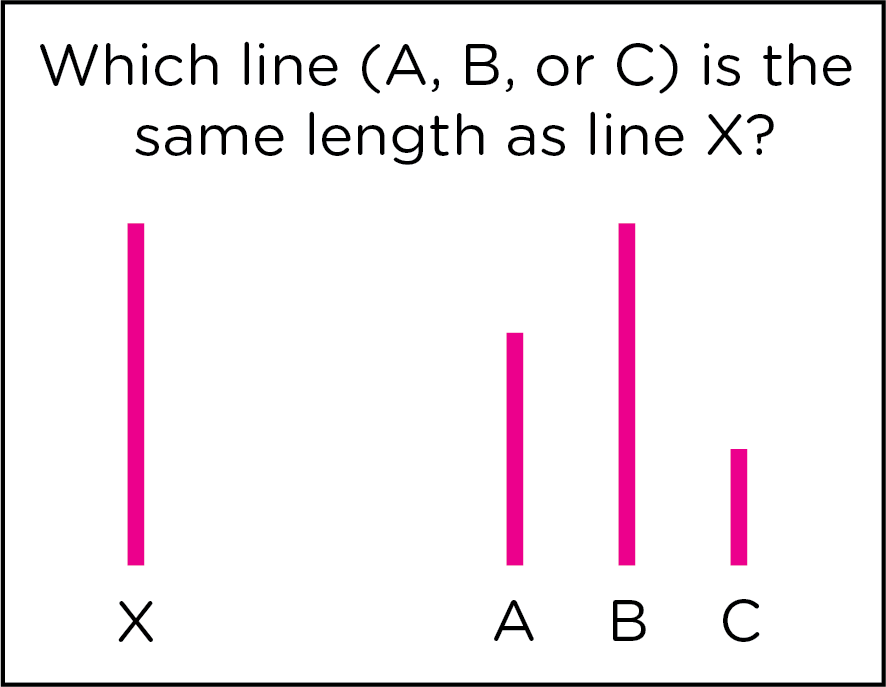
- Method: Asch created an artificial environment where people believed they were taking part in a vision test. He asked the students to make judgements on a simple line task and ask to compare them to a line marked ‘X’. Asch had set up the room with seven confederates and only one naïve participant. The confederates had been told to purposely answer the task incorrectly. This was to test whether it would influence the naïve participant to conform. He ensured that the naïve participant was sat last or second to last to guarantee that the naïve participant had heard the confederates’ answers first.
- Results: 75% of people conformed at least once. The overall conformity rate was at 37%. When there was no unanimity, the conformity rate dropped to 5%.
- Variations: Asch and subsequent researchers also investigated the conditions that affect conformity rates, including:
- Group size: with a group of three, the conformity rate grew to 31%. When he increased the number, there was an insignificant increase in conformity rate – 37% was the highest when in a group of 7. He concluded that only 3 people are needed for conformity to take place.
- Task difficulty: if the task is more difficult, the conformity rate increases. This is because when people are unsure in a situation, they look to others for the correct answer. Therefore, when the task is easier, people are less likely to be influenced by others.
- Unanimity: in a variation, a confederate was told to give correct answers. When another person gave correct answers, the conformity rate dropped to around 5%. Therefore, if unanimity is broken, the rate of conformity is reduced.
- Evaluation:
- Highly controlled study: lab experiments have high internal validity, so Asch’s results wouldn’t be affected by extraneous variables.
- Cultural bias: may only have produced these findings because of the context of the time. It was conducted in 1950s America during the Cold War where being seen as the ‘odd one out’ was dangerous. Conformity and solidarity was seen as the norm in society and any deviation from these views was viewed as ‘un-American.’ Therefore, results may not be generalisable across time periods and cultures.
- Only used males: the results are not generalisable to women or fully representative of the population.
- Ethical issues: Asch’s study used deception as the participants were led to believe that they were in a room of naïve participants when they were actually confederates. Another ethical issue is psychological distress, as the naïve participants were led to believe that an obvious correct answer was incorrect. This may have led to stress and confusion.
Unlock Asch’s research into conformity
Subscribe to SnapRevise+ to get immediate access to the rest of this resource.
Premium accounts get immediate access to this resource.