

Topic Summaries
The multi-store memory model
A-Level
>
Psychology
>
AQA
>
A-Level Psychology Topic Summaries
>
Memory
>
The multi-store memory model
Social influence
Memory
Attachment
Approaches in psychology
Biopsychology
Clinical psychology and mental health
Research methods
Issues and debates
Relationships
Gender
Cognition and development
Schizophrenia
Stress
Eating behaviour
Aggression
Forensic psychology
Social influence
Memory
Attachment
Approaches in psychology
Biopsychology
Clinical psychology and mental health
Research methods
Issues and debates
Relationships
Gender
Cognition and development
Schizophrenia
Stress
Eating behaviour
Aggression
Forensic psychology
- Features of memory:
- Capacity: the amount of information that can be held in a memory store.
- Duration: the length of time information can be held in our brains.
- Coding: how we process the information.
- The multi-store memory model:
- Created by 👥 Atkinson and Shiffrin (1968) to describe how information flows through the memory system.
- The model is structured with three separate stores and linear information flow.
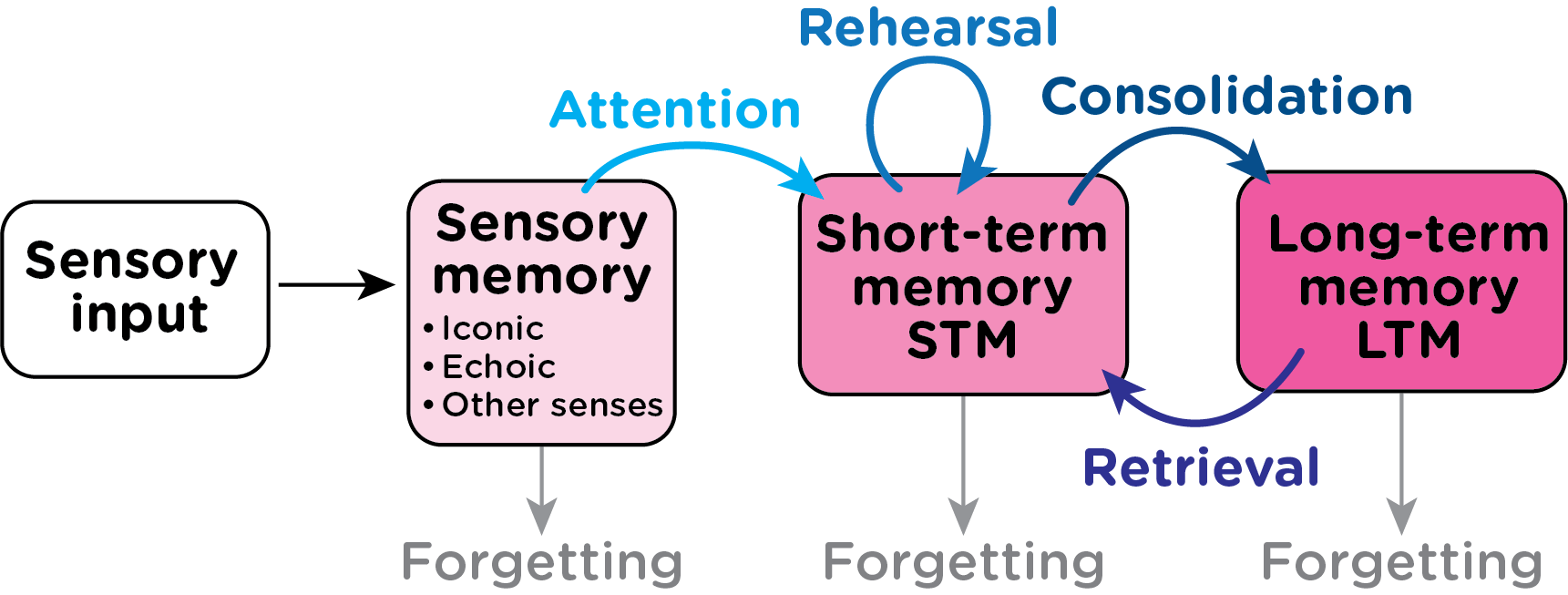
- Features of the stores:
- Short term memory (STM): the duration is between 18–30 seconds unless it is rehearsed.It has limited capacity (7 ± 2 items) and information in this store is coded acoustically.
- Long term memory (LTM): the duration is partially permanent when information has been rehearsed. The capacity is seemingly unlimited and the information is coded semantically.
- Sensory register: the duration is less than a second.It has a very large capacity and it codes echoic and iconically. A stimulus from the environment passes into the sensory register. The sensory register gathers its information from the environment. Most of the information receives no attention. Only information that has attention paid to it will pass to the short-term memory. The sensory register has five stores (one for each of the senses) but the main ones are the echoic and iconic stores:
- Echoic: auditory information, coded acoustically.
- Iconic: visual information, coded visually.
- Maintenance rehearsal: this is where we repeat information to ourselves. It increases the amount of time that information will be held in the STM. If it is done for long enough, the information will pass into the LTM.
- Retrieval: when information is recalled from the LTM to the STM.
- Evaluation of the multi-store memory model:
- 👥 Wilson, Kopelman, and Kapur (2008) studied a musician named Clive Wearing who contracted a brain infection that left him with a memory span of less than 30 seconds. However, his musical ability remained intact. This supports the multi-store memory model as it shows there are different stores for memory (i.e. he has LTM but no STM).
- 👥 Shallice and Warrington (1974) studied a brain-damaged patient KF whose short-term memory was severely compromised, only being able to remember 2 items instead of the average 7. When it was tested visually, it was close to normal, but when testing in an auditory way, he had bad recall. This criticises the multi-store memory model as it suggests that there has to be more than one STM.
Unlock The multi-store memory model
Subscribe to SnapRevise+ to get immediate access to the rest of this resource.
Premium accounts get immediate access to this resource.