

Topic Summaries
Learning theory
Social influence
Memory
Attachment
Approaches in psychology
Biopsychology
Clinical psychology and mental health
Research methods
Issues and debates
Relationships
Gender
Cognition and development
Schizophrenia
Stress
Eating behaviour
Aggression
Forensic psychology
Social influence
Memory
Attachment
Approaches in psychology
Biopsychology
Clinical psychology and mental health
Research methods
Issues and debates
Relationships
Gender
Cognition and development
Schizophrenia
Stress
Eating behaviour
Aggression
Forensic psychology
- The learning theory: states that behaviour is learnt and not innate: all behaviour is acquired through conditioning – operant or classical.
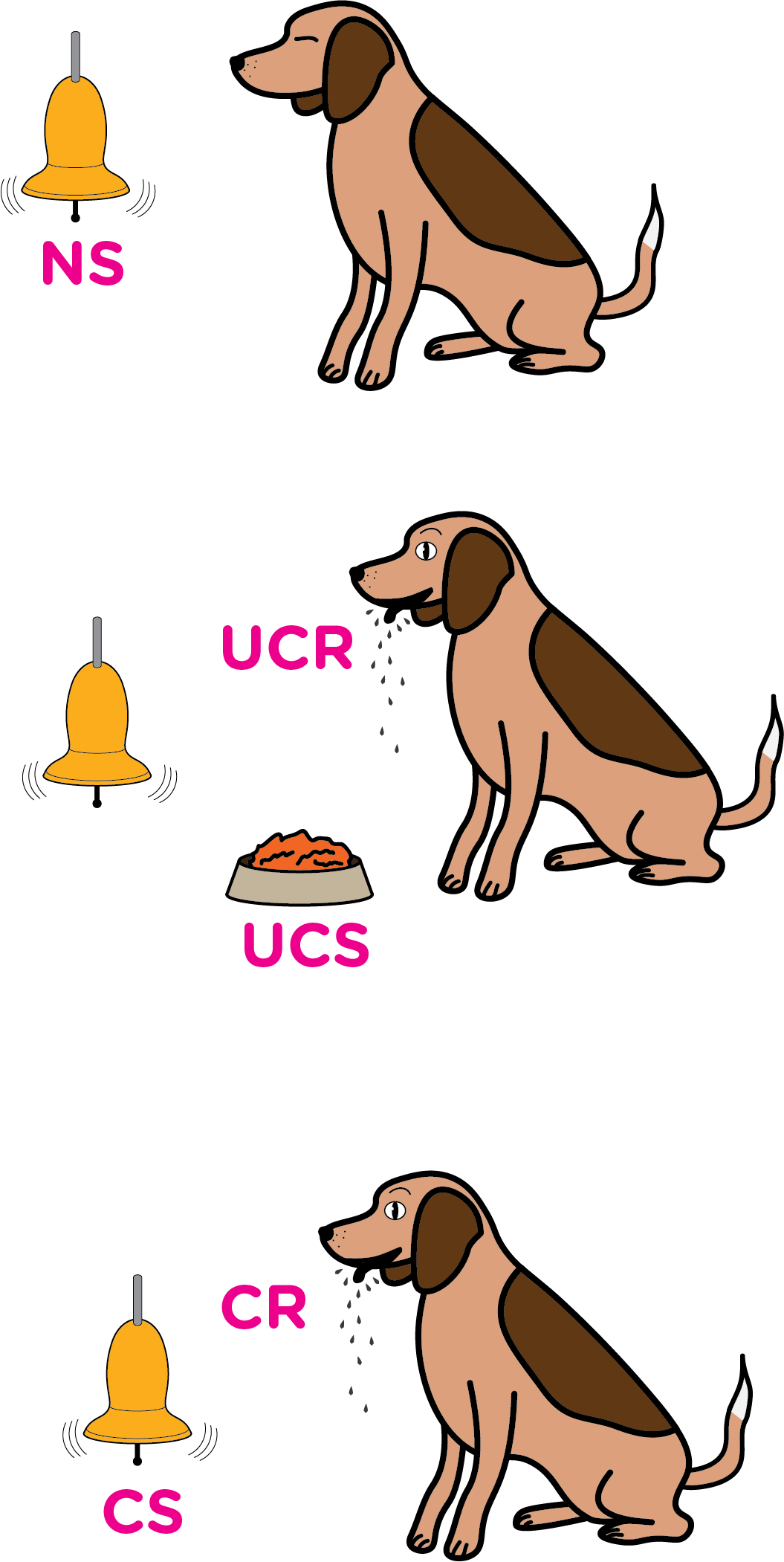
- Classical conditioning: when we unconsciously learn to associate a stimulus that brings a natural response to another, learnt stimulus to give the same response. This was demonstrated by 👥 Ivan Pavlov (1897) who outlined the process of classical conditioning in dogs:
- There is an unconditioned stimulus (food) that brings about an unconditioned response (dog drooling).
- The bell (neutral stimulus) is a new stimulus that doesn’t lead to any response but is paired with the unconditioned stimulus to elicit the unconditioned response and make it a conditioned response.
- When the neutral stimulus has become associated with the unconditioned stimulus, it becomes a conditioned stimulus, which has a conditioned response (i.e.the dog expects food to appear when the bell rings, so the dog starts to drool at the bell even when there is no food).
- This theory has been applied to attachment where food is an unconditioned stimulus that elicits the unconditioned response of happiness in a baby, and the mother is a neutral stimulus that becomes conditioned over time so that the baby is happy upon seeing the mother, associating her presence with food.
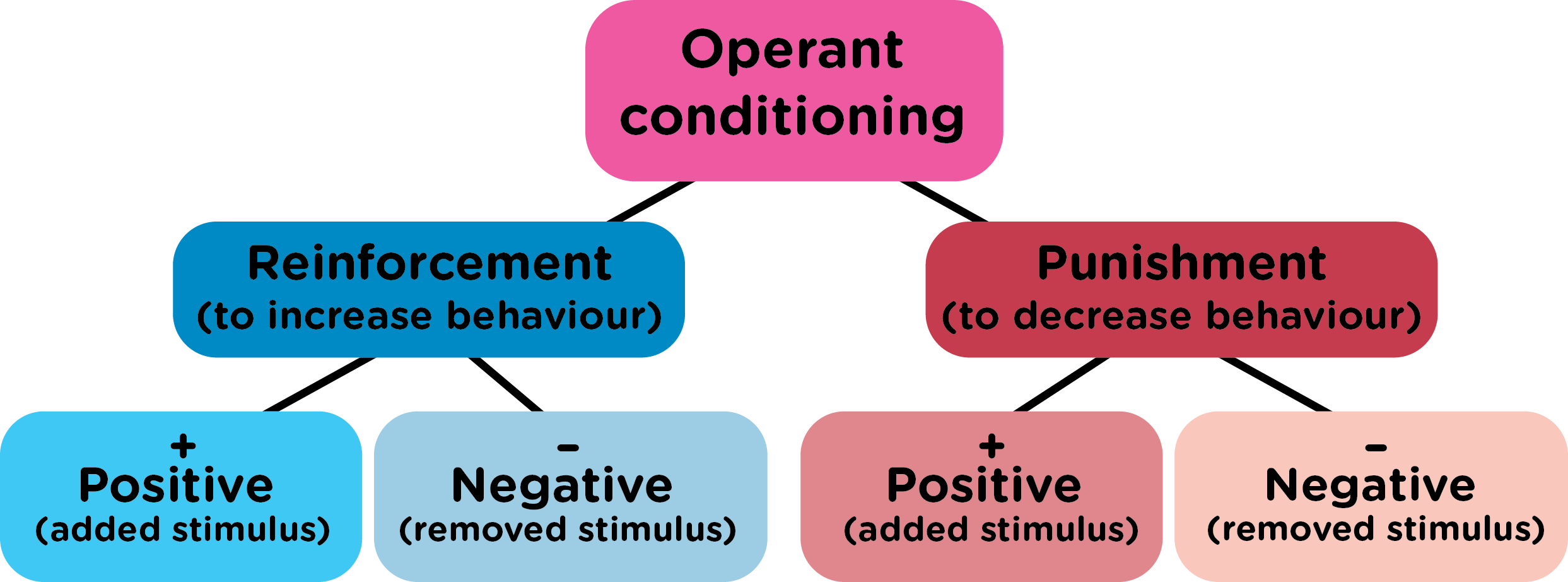
- Operant conditioning: is a process that attempts to modify behaviour through the use of positive and negative reinforcement or punishment.
- Positive reinforcement: when a desirable stimulus is added to encourage behaviour. In these situations, rewards are used to increase positive behaviour to ensure it continues (e.g.giving a child a sticker on a highly graded assessment).
- Negative reinforcement: when an aversive stimulus is removed in order to encourage behaviour (e.g.a teacher ending detention early because the class was well-behaved).
- Positive punishment: when an unfavourable consequence is added in order to weaken the response (e.g.giving a student a detention for misbehaving).
- Negative punishment: removing something good after an undesired behaviour to try and stop the behaviour from being repeated (e.g.taking away a child’s ice-cream for screaming).
- Evaluation of the learning theory:
- Animal studies: the majority of learning theory is based on animal studies. This is a significant limitation of the research as humans are more complex and have higher levels of consciousness than animals, so this research may not be generalisable.
- Simplistic: the assumption of reinforcement through feeding is too simplistic to fully explain attachment. Alternate research suggests that the responsiveness and attention offered by a parent may reinforce behaviour. Therefore, feeding alone cannot explain the bond between a parent and child. Additionally, the main feeder of a child may not always be the primary caregiver (e.g. a nanny may feed the child more often).
- 👥 Schaffer and Emerson (1964) discovered that babies had formed a primary attachment to their mother even if they were not the main feeder. Their study showed that children formed the strongest attachment to the person who showed the most responsiveness to their emotional needs.
Unlock Learning theory
Subscribe to SnapRevise+ to get immediate access to the rest of this resource.
Premium accounts get immediate access to this resource.