

Topic Summaries
The nervous system
A-Level
>
Psychology
>
AQA
>
A-Level Psychology Topic Summaries
>
Biopsychology
>
The nervous system
Social influence
Memory
Attachment
Approaches in psychology
Biopsychology
Clinical psychology and mental health
Research methods
Issues and debates
Relationships
Gender
Cognition and development
Schizophrenia
Stress
Eating behaviour
Aggression
Forensic psychology
Social influence
Memory
Attachment
Approaches in psychology
Biopsychology
Clinical psychology and mental health
Research methods
Issues and debates
Relationships
Gender
Cognition and development
Schizophrenia
Stress
Eating behaviour
Aggression
Forensic psychology
The nervous system is separated into two divisions: the central nervous system and the peripheral nervous system.
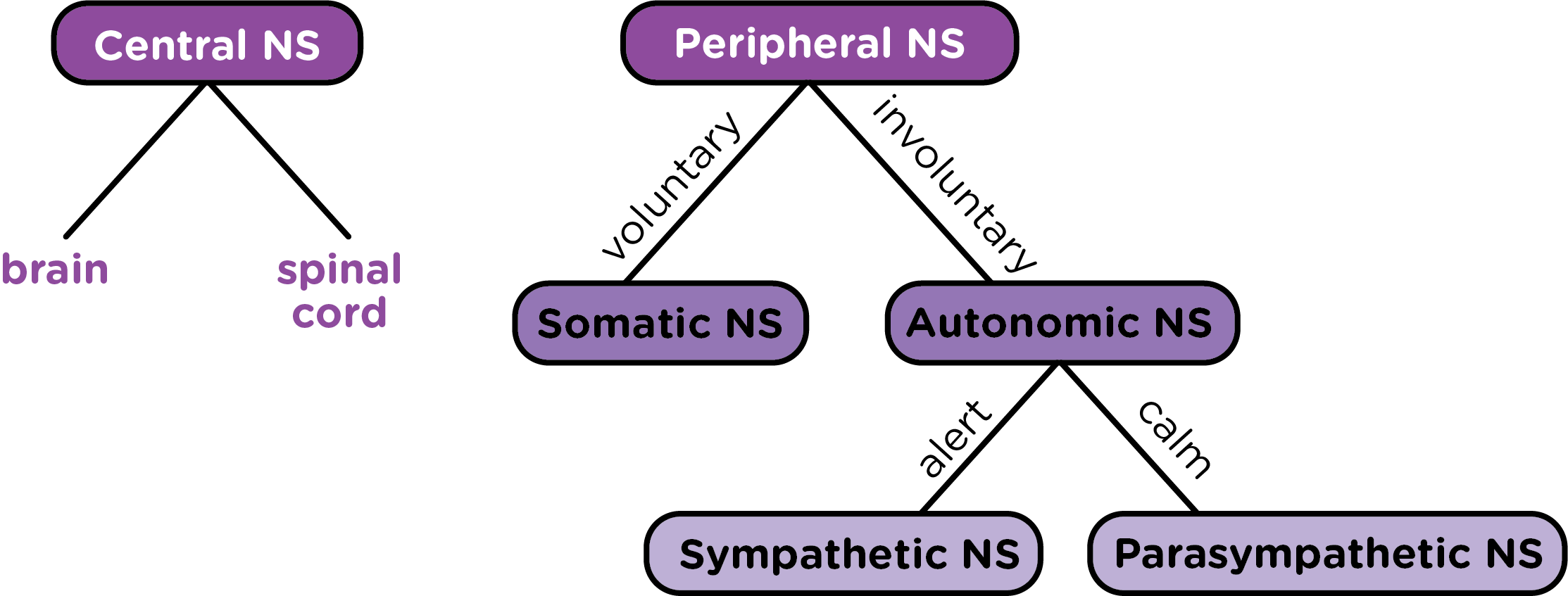
- The central nervous system:
- The brain: receives and process information from the senses. It contains our conscious awareness, imitates responses, stores memories, and generates emotions and thoughts.
- The spinal cord: conducts signals to and from the brain. It controls our reflex actions.
- The peripheral nervous system: sends messages to and from the central nervous system via neurons and is separated into two parts: the autonomic nervous system and the somatic nervous system.
- The autonomic nervous system: involuntary responses. This system only has motor pathways and doesn’t directly control effectors. It’s separated into the sympathetic branch and the parasympathetic branch:
- Sympathetic branch: the fight or flight response that prepares the body to confront a threat when stressed.
- Sympathetic branch: restores and conserves the body’s energy when relaxed or after a threat has passed.
- The somatic nervous system: voluntary movements. This system is made up of motor and sensory pathways, and it can control effectors directly.
- The autonomic nervous system: involuntary responses. This system only has motor pathways and doesn’t directly control effectors. It’s separated into the sympathetic branch and the parasympathetic branch:
Unlock The nervous system
Subscribe to SnapRevise+ to get immediate access to the rest of this resource.
Premium accounts get immediate access to this resource.